
How to Learn Tarot Card Meanings Without Memorising
Seventy-eight cards is a lot to memorise and you do not have to. The structure that turns most of the deck into logic, and the habit that does the rest.
 Two of Wands
Wands · Number 2
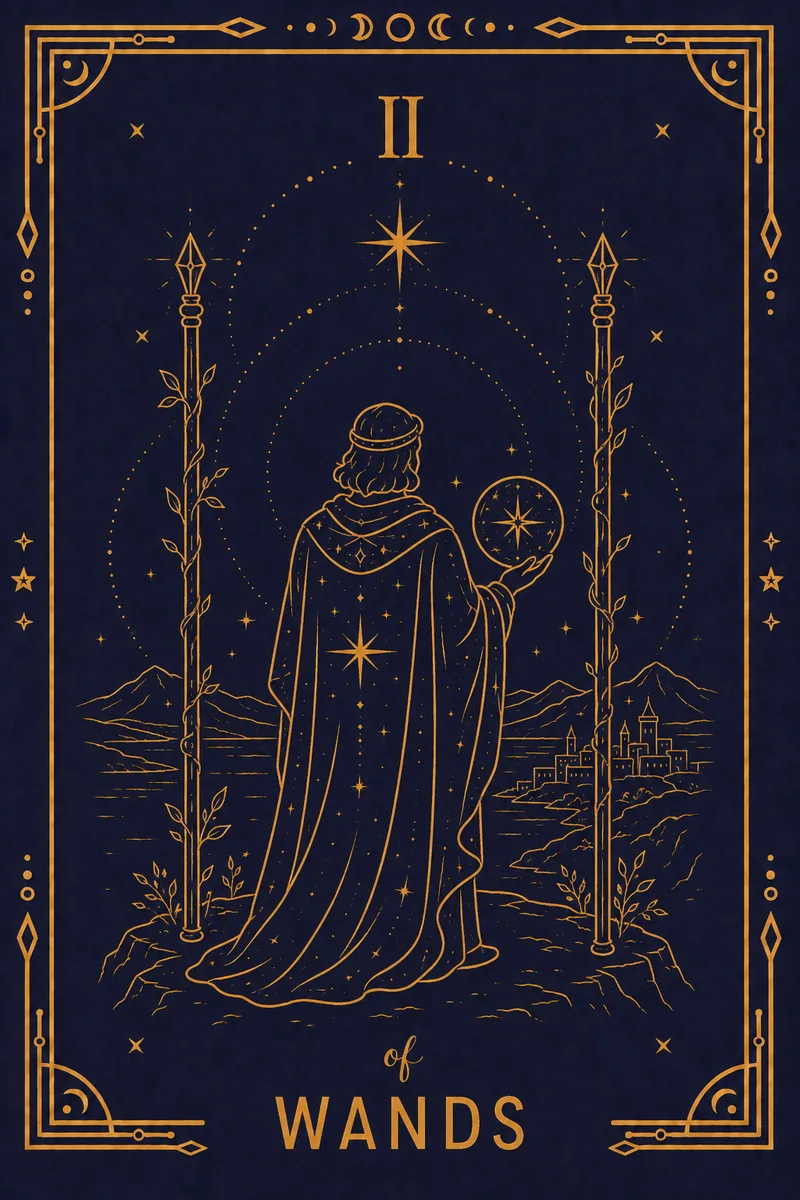
The Two is planning with the world in your hand and your feet still at home. The first success has happened. The question is whether you will stay with it or leave for something larger. **He owns the fortress and is looking past it.** One wand is fixed to the wall and the other he holds, and the whole card is in the direction of his gaze. Smith invented the globe and the merchant's vantage; the Marseille original showed two crossed batons and nothing else.
Affirmation
“I choose the larger world over the comfortable one.”
The Two is planning with the world in your hand and your feet still at home.
The first success has happened. The question is whether you will stay with it or leave for something larger.
He owns the fortress and is looking past it. One wand is fixed to the wall and the other he holds, and the whole card is in the direction of his gaze. Smith invented the globe and the merchant's vantage; the Marseille original showed two crossed batons and nothing else.
Long-range planning, weighing options, deciding to expand.
You have proved the concept. Now choose a direction and commit resources to it, which is the step this card describes and the one that gets deferred.
In an advice position it favours the larger world over the comfortable one, and it is honest that the comfortable one is genuinely comfortable. This is not a card about escaping something bad.
Fear of leaving what works. Planning that never becomes movement.
Or plans made without the information to make them, which is the opposite failure and produces a confident decision about a place nobody has visited.
The commonest reading is playing small: an ambition scaled down until it is safe, described afterwards as realism.
Deciding whether a relationship has a future worth planning for.
The card describes the point where something has been established and the next move requires a commitment of some kind: moving in, moving cities, deciding this is the one worth reorganising a life around.
Reversed, staying in the comfortable option out of fear of the unknown one. That covers both staying in a relationship and staying single, and the card does not prefer either. What it objects to is the choice being made by default.
As somebody's feelings, it reads as seriously considering you rather than swept up: this person is weighing a future, which is more flattering and less immediate than it sounds.
Strategy, expansion, a decision between security and opportunity.
It is the card of the successful small thing deciding whether to become a bigger thing: the freelancer considering staff, the business considering premises, the specialist considering a wider role.
Reversed, a plan that has stayed a plan too long. The practical reading is that the decision is available now and will not stay available, because the vantage in the picture depends on the first success still being current.
Financial planning and considered risk. Investing in growth rather than banking the win.
The card favours deploying resources rather than protecting them, which distinguishes it sharply from the Four of Pentacles and makes the pair worth reading together when both appear.
Reversed, a plan with no numbers in it. Fire is the suit of ambition and this is where ambition most needs a spreadsheet attached.
The distance between the world you have and the world you can see.
Discontent treated as information rather than as ingratitude, which is the card's most useful spiritual claim and cuts against a great deal of received advice about contentment.
Associated with vocation in its restless form, and with the observation that a person who can see further than their current life is not necessarily failing to appreciate it.
Planning a change rather than making one.
Read as reflection rather than diagnosis, the card sits at the point where somebody has decided something needs to be different and has not yet started. That is a real stage and it is not the same as doing nothing.
Its counsel is to set the programme now, while the intention is live, and to make the first appointment rather than the whole plan. Anything symptomatic belongs with a doctor rather than a programme.
For reflection and entertainment. Not medical, legal, or financial advice.
A man in a castle holds a small globe and looks out over the sea; one wand is fixed to the wall, the other he holds. He owns the fortress and is looking past it. The whole card is in the direction of his gaze.
Waite's design departs sharply from the Marseille pips, which showed only two crossed batons. The globe and the merchant's vantage are Pamela Colman Smith's invention and are the reason the card reads as ambition rather than mere pairing.
Written by Memento Arcana against the Rider-Waite-Smith deck and the Golden Dawn attributions it was built on. No part of it was generated by a language model. Last updated 17 August 2026.
Where traditions disagree about this card, the page says so rather than picking one quietly. How we write these, and our sources.
How Two of Wands has actually shown up for other readers.
Nothing here yet. Be the first to say how this card has landed for you.
Guides to reading this card alongside the other 77.
Seventy-eight cards is a lot to memorise and you do not have to. The structure that turns most of the deck into logic, and the habit that does the rest.
Two cards together mean more than two cards apart. A four-step method: dominant card, elements, the tension between them, then back to your question.
The 22 majors are the themes you do not choose. The 56 minors are daily life. What each half does, and what it means when one dominates a reading.