
The Lovers - Unisex Tee
From £17.95
View item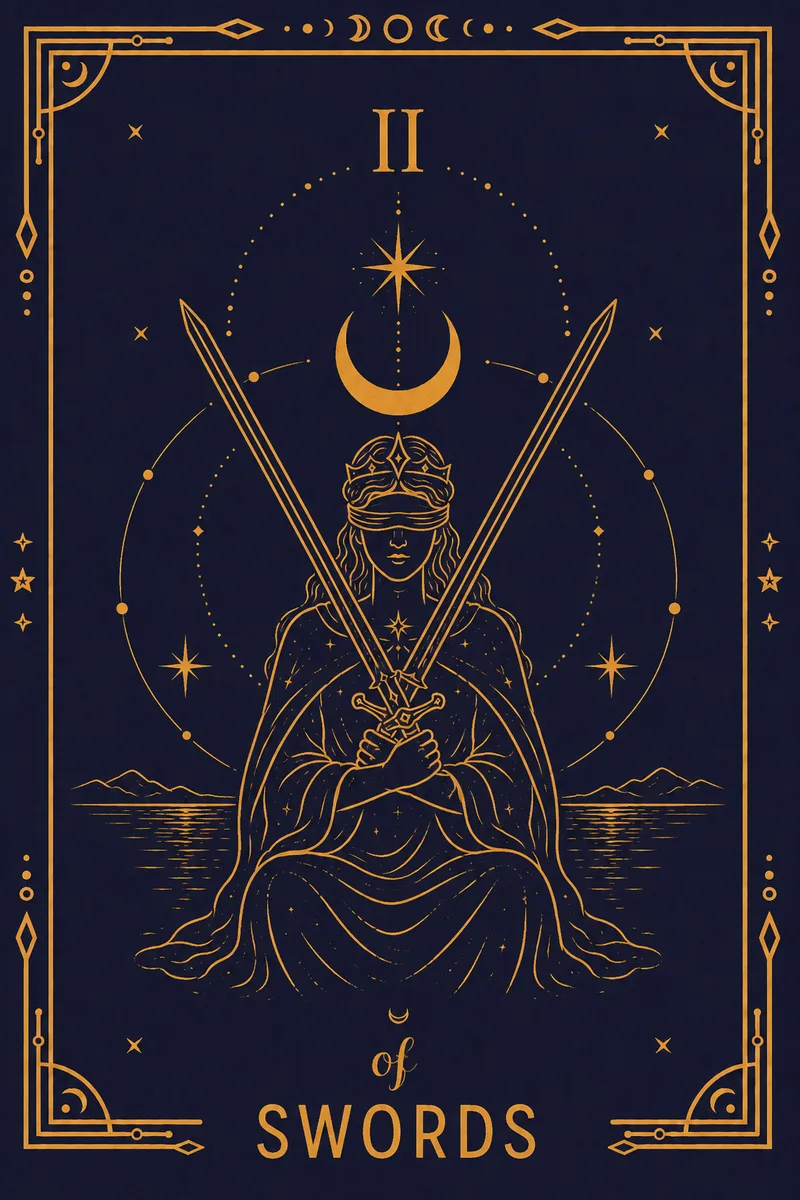 Two of Swords
Swords · Number 2
The Two is stalemate maintained by refusing to look. Blindfolded, arms crossed, two blades held in perfect balance: **a peace that only holds as long as nothing moves.** Golden Dawn titled it Peace Restored, which is unusually ironic given the picture. Waite's blindfold is the addition that turned a card about balance into a card about refusal, and her crossed arms form an X over her heart: the intellect protecting her from her own feeling.
Affirmation
“I take the blindfold off and look.”
The Two is stalemate maintained by refusing to look.
Blindfolded, arms crossed, two blades held in perfect balance: a peace that only holds as long as nothing moves.
Golden Dawn titled it Peace Restored, which is unusually ironic given the picture. Waite's blindfold is the addition that turned a card about balance into a card about refusal, and her crossed arms form an X over her heart: the intellect protecting her from her own feeling.
An avoided decision. Blocked information, often self-blocked. A truce that resolves nothing.
The card's sharpest claim is that you already have enough to choose and are declining to. That is not always true and it is true more often than people want, and the card is the deck's most direct challenge on the point.
In an advice position it asks a single question: what would you have to do if you looked? The answer usually explains the blindfold.
The blindfold coming off. Information arriving, a decision finally made.
Or overwhelm as the standoff collapses, which is the version where everything that was being held apart arrives at once.
The useful reading is that the balance was costing more than it appeared to. Holding two swords level is not restful, and people rarely notice how much effort a stalemate takes until it ends.
Refusing to address something. A relationship in suspended animation.
It is the card of two people being scrupulously polite about the thing neither will raise. Nothing is wrong on the surface and nothing is moving, and both parties usually know precisely what the subject is.
Reversed, a difficult conversation finally happening, which the card treats as good news even when it goes badly. The tradition is consistent here: the stalemate is not a neutral state, and time spent in it is not free.
As somebody's feelings, it reads as deliberately not decided: this person is holding themselves at a distance from their own answer, which is a real position and an unsatisfying one to be on the other side of.
A decision deferred, two options held indefinitely, or a workplace problem everybody has agreed not to see.
The organisational version of this card is common: an issue known to everyone, discussed in pairs, never raised in the room where it could be settled.
The practical reading is that the deferral is now the decision. Options do not stay open indefinitely, and this card usually appears somewhat after the point where they closed.
Avoiding looking at the accounts, and a financial decision postponed past its useful window.
The card is precise about the mechanism: the not-looking is protective, it works, and it works by making the situation worse slowly enough not to trigger anything.
Its counsel is one afternoon. Open everything, write down the real numbers, and do nothing else that day. The looking is the whole task, and almost everything else follows from it.
Willed blindness, and the card asks what you would have to do if you looked.
It is the counterpart to the Ace: where that one cuts through, this one declines to. The tradition treats deliberate not-knowing as a real spiritual condition rather than as mere ignorance, because it takes effort to maintain.
Associated with the practice of sitting with a question you have been avoiding, and with the observation that most people know their answer and are negotiating with it.
Ignoring symptoms, and stress from unresolved tension.
Read as reflection rather than diagnosis, this is the card of the thing not looked at: the lump not mentioned, the pain explained away, the appointment not made because of what it might find.
The honest note is short and matters more than anything else on this card. Not knowing is not the same as it not being there, and most things found early are more treatable than things found late. Make the appointment.
For reflection and entertainment. Not medical, legal, or financial advice.
A blindfolded woman sits before still water holding two crossed swords, the crescent moon above. Her arms form an X across her heart. The intellect is protecting her from her own feeling.
Golden Dawn titled it Peace Restored, which is unusually ironic given the imagery. Waite's blindfold is the addition that turned a card about balance into one about refusal.
Written by Memento Arcana against the Rider-Waite-Smith deck and the Golden Dawn attributions it was built on. No part of it was generated by a language model. Last updated 17 August 2026.
Where traditions disagree about this card, the page says so rather than picking one quietly. How we write these, and our sources.
How Two of Swords has actually shown up for other readers.
Nothing here yet. Be the first to say how this card has landed for you.
Browse Our Store
Tarot decks, journals, prints and apparel, shipped worldwide.
Guides to reading this card alongside the other 77.
Seventy-eight cards is a lot to memorise and you do not have to. The structure that turns most of the deck into logic, and the habit that does the rest.
Two cards together mean more than two cards apart. A four-step method: dominant card, elements, the tension between them, then back to your question.
The 22 majors are the themes you do not choose. The 56 minors are daily life. What each half does, and what it means when one dominates a reading.