
The Lovers - Unisex Tee
From £17.95
View item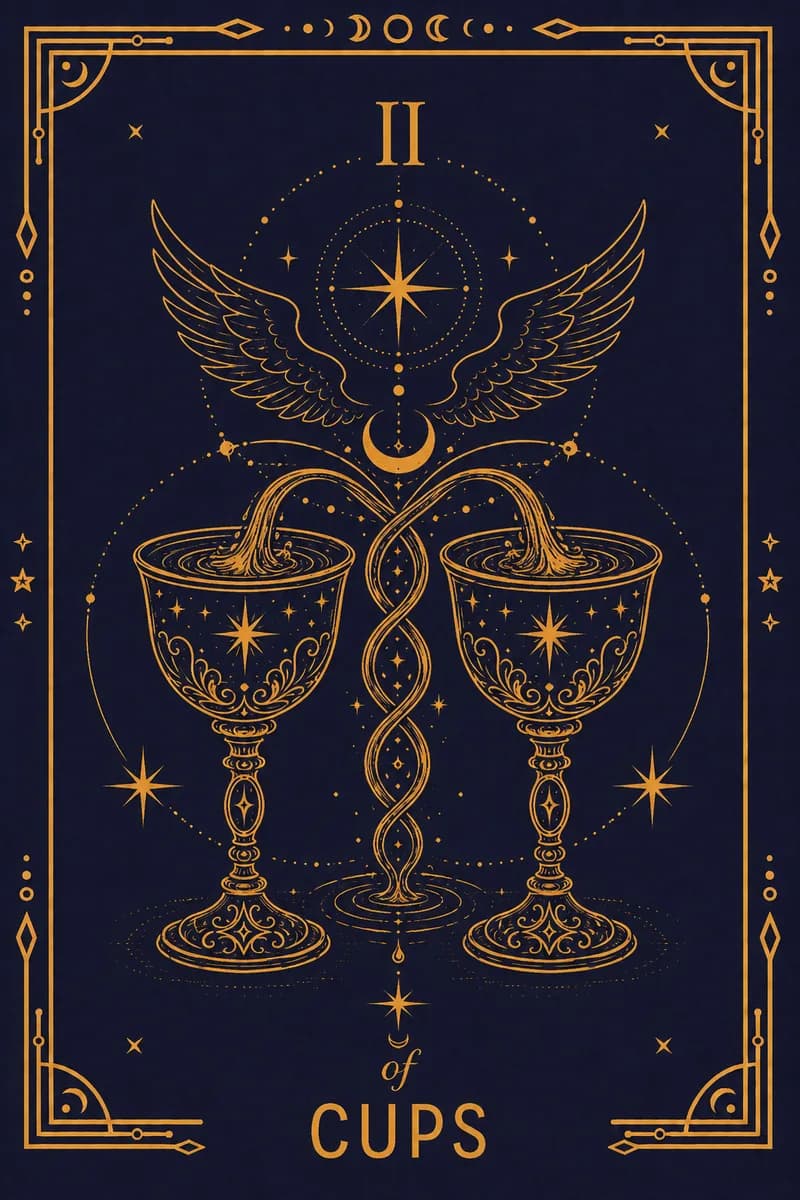 Two of Cups
Cups · Number 2
The Two is mutual recognition. Two people meeting as equals and each choosing the other. It is the minor-arcana echo of The Lovers, scaled down from destiny to an actual relationship between two actual people, and the reduction is a gain rather than a loss. **The Lovers asks what a union costs; the Two of Cups describes the union working.** The gesture in the picture is symmetrical, and that is the whole card. Neither figure is offering more than the other, and the caduceus rising between them, topped with a winged lion's head, is healing produced by the exchange itself rather than by either person.
Affirmation
“I meet you as an equal or not at all.”
The Two is mutual recognition. Two people meeting as equals and each choosing the other.
It is the minor-arcana echo of The Lovers, scaled down from destiny to an actual relationship between two actual people, and the reduction is a gain rather than a loss. The Lovers asks what a union costs; the Two of Cups describes the union working.
The gesture in the picture is symmetrical, and that is the whole card. Neither figure is offering more than the other, and the caduceus rising between them, topped with a winged lion's head, is healing produced by the exchange itself rather than by either person.
Partnership, attraction, a bond formed in balance. Reconciliation after a break.
What distinguishes it from every other connection card is reciprocity. Whatever is being offered here is being offered both ways, and the tradition treats that as the mechanism rather than a happy accident: the thing works because it is even.
In an advice position it favours meeting somebody halfway and saying so out loud. It is a poor card for waiting to be approached and a good one for the conversation that formalises something already true.
Imbalance: one giving, one taking. A break, a falling-out, or a connection that never becomes mutual.
The distinguishing question is whether the asymmetry is temporary. Every relationship spends periods uneven, and the card reversed describes the state where it has stopped correcting: one person adjusting continuously while the other does not notice there is anything to adjust.
Sometimes it reads as self-regard needing to come first, which is the gentler version and appears where somebody has been meeting everybody halfway and nobody has been walking towards them.
The clearest partnership card in the deck: a significant relationship, an engagement, a reconciliation.
Equality is its distinguishing feature and its actual content. This is not the card of overwhelming feeling, which is the Ace, nor of a decision, which is The Lovers. It is two people seeing each other accurately and choosing on that basis, which is the least dramatic and most durable of the three.
Reversed, the reading is rarely about betrayal. It is usually about a slow slide into one person doing the emotional work, and the tradition is even-handed about how that happens: nobody arranges it, and both people participate in it continuing.
As somebody's feelings, it is the best answer in this position that the deck reliably gives: mutual, aware and directed at you specifically. It says nothing about timing, and mutual feeling has never guaranteed a workable situation.
A working partnership, a good hire, a contract signed in good faith. Collaboration that genuinely benefits both sides.
It favours arrangements between two parties rather than within a hierarchy: co-founders, a supplier relationship that works, a mentor and a protégé who both get something. Also strong for negotiation, on the grounds that a deal both sides like tends to survive.
The practical reading is that the terms are the relationship. Where somebody is entering a working partnership on enthusiasm and vague intentions, this card is quietly recommending they write it down while everybody still likes each other.
Shared finances, a joint venture, a fair deal.
The card is comfortable with money that is entangled with a relationship, which is unusual, and its one condition is that the arrangement be even and understood by both parties.
Reversed, a financial imbalance nobody has named: unequal contributions to a household, a loan between friends that has quietly become a gift, a partnership where one side is carrying the costs. The card asks for it to be said rather than resented.
The union of opposites at human scale, and relationship treated as a spiritual practice rather than a distraction from one.
The caduceus makes the claim explicit: something is healed by the exchange that neither figure could produce alone. That is an old idea and the card puts it plainly.
Associated with practice done in company, with the discipline of being genuinely known, and with the observation that most of what a person cannot see about themselves is visible to somebody who loves them.
Healing supported by another person. Partnership in recovery, and the traditional associations are the heart and the blood.
Read as reflection rather than diagnosis, the card describes the difference another person makes: the appointment somebody comes with you to, the habit that only holds because it is shared, the recovery that is being witnessed rather than managed alone.
Reversed, the health cost of carrying a relationship single-handed, which is real and is easier to see from outside. Anything physical belongs with a doctor rather than with a card.
For reflection and entertainment. Not medical, legal, or financial advice.
Two figures exchange cups beneath the caduceus of Hermes topped by a winged lion's head, healing and the raising of something between them. The gesture is symmetrical; neither is offering more than the other.
Golden Dawn titled it Love. The caduceus is Smith's addition and imports a healing dimension the older pip cards had no way to carry.
Written by Memento Arcana against the Rider-Waite-Smith deck and the Golden Dawn attributions it was built on. No part of it was generated by a language model. Last updated 17 August 2026.
Where traditions disagree about this card, the page says so rather than picking one quietly. How we write these, and our sources.
How Two of Cups has actually shown up for other readers.
Nothing here yet. Be the first to say how this card has landed for you.
Browse Our Store
Tarot decks, journals, prints and apparel, shipped worldwide.
Guides to reading this card alongside the other 77.
Seventy-eight cards is a lot to memorise and you do not have to. The structure that turns most of the deck into logic, and the habit that does the rest.
Two cards together mean more than two cards apart. A four-step method: dominant card, elements, the tension between them, then back to your question.
The 22 majors are the themes you do not choose. The 56 minors are daily life. What each half does, and what it means when one dominates a reading.