
The Lovers - Unisex Tee
From £17.95
View item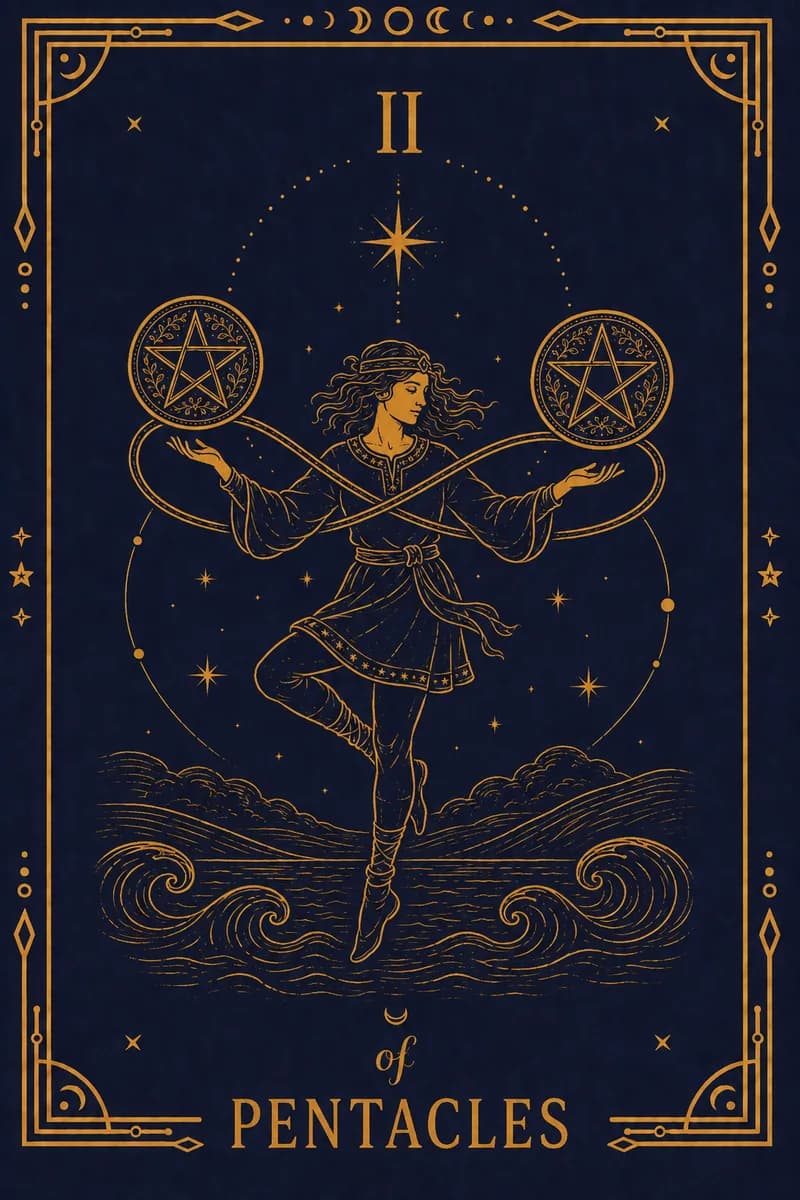 Two of Pentacles
Pentacles · Number 2
The Two is juggling: multiple demands kept in the air by continuous small adjustments. It works, and **it is not the same as stability**, which is the distinction the card exists to make. Nothing is falling. Nothing can be put down either. The two coins are linked by a lemniscate, The Magician's infinity loop appearing here as a rope tying two things together. Behind the juggler, two ships ride very large waves. He is managing well and the conditions are genuinely rough, and Smith drew both facts into the same picture.
Affirmation
“I can hold this, and I will notice when I cannot.”
The Two is juggling: multiple demands kept in the air by continuous small adjustments.
It works, and it is not the same as stability, which is the distinction the card exists to make. Nothing is falling. Nothing can be put down either.
The two coins are linked by a lemniscate, The Magician's infinity loop appearing here as a rope tying two things together. Behind the juggler, two ships ride very large waves. He is managing well and the conditions are genuinely rough, and Smith drew both facts into the same picture.
Balancing priorities, adapting, managing more than one thing at once. You are handling it.
Flexibility is the skill here rather than control, and the card is complimentary about it. Juggling is a competence, and the person doing it is usually being judged for not having a tidier life instead.
In an advice position it favours adjusting rather than resolving. Whatever this is, it does not need to be fixed permanently this week; it needs to stay in the air until the sea settles.
Dropping one. Overcommitted, disorganised, robbing one obligation to pay another.
The juggling has stopped working, and the tell is usually borrowing: time taken from one commitment to cover another, then repaid from a third. That pattern is visible in a diary long before it is visible in an outcome.
The useful reading is that the load is the problem rather than the technique. More organisation applied to too much produces a better-organised version of the same failure.
Balancing a relationship against everything else: work, family, money, the other things that have to be kept moving.
The card is sympathetic rather than critical. It describes somebody doing their best across too many claims, and it does not suggest that the relationship should automatically win.
Reversed, a partner receiving whatever is left after everything else has been served. That is the specific failure and it is rarely a decision; it is the residue of a schedule. The card is asking whether the arrangement has ever been looked at as a whole.
As somebody's feelings, it reads as genuine but stretched: interest is real and attention is contested, and this person is probably aware they are not giving it what they would like to.
Multiple projects, competing deadlines, adapting continuously. The card of the person keeping several things going and being asked for one more.
It favours flexible, responsive roles and describes them accurately: freelancing, small business, anything where the week rearranges itself. Jupiter in Capricorn gives it capacity rather than ease.
Reversed, too many plates and one about to go, and the practical counsel is to choose which one deliberately rather than letting the choice be made by whichever is dropped.
Cash flow management: moving money to cover obligations, working, and precarious.
This is the most accurate financial card in the deck for a great many people. Not poverty and not comfort, but a system that functions as long as nothing unexpected happens.
Its one warning is about slack. A plan with no margin is a plan that only works in good weather, and the ships behind the juggler are the reminder that the weather is not currently good.
Flow and adaptation, and balance understood as a continuous act rather than a state you reach.
The card sits against every version of practice that requires calm conditions. Its position is that equilibrium is something being done, moment by moment, rather than something achieved and then possessed.
Associated with practice that survives a chaotic life by being small and portable rather than by waiting for the life to settle, on the grounds that the settling is not coming.
Stress from constant juggling, and a body paying for a schedule that never has slack in it.
Read as reflection rather than diagnosis, the card describes a specific and common state: nothing is wrong, everything is slightly too much, and the cost is accumulating somewhere that has not been checked.
Its counsel is structural rather than restorative. Rest inside an unchanged schedule is absorbed by the schedule, and the card is pointing at the load. Anything that has become physical belongs with a doctor.
For reflection and entertainment. Not medical, legal, or financial advice.
A figure dances while juggling two coins linked by a lemniscate: the infinity loop from The Magician, here as a rope keeping two things tied together. Behind him, two ships ride very large waves.
Golden Dawn titled it Harmonious Change. The ships in heavy sea are Smith's comment: the juggler is managing well, and the conditions are genuinely rough.
Written by Memento Arcana against the Rider-Waite-Smith deck and the Golden Dawn attributions it was built on. No part of it was generated by a language model. Last updated 17 August 2026.
Where traditions disagree about this card, the page says so rather than picking one quietly. How we write these, and our sources.
How Two of Pentacles has actually shown up for other readers.
Nothing here yet. Be the first to say how this card has landed for you.
Browse Our Store
Tarot decks, journals, prints and apparel, shipped worldwide.
Guides to reading this card alongside the other 77.
Seventy-eight cards is a lot to memorise and you do not have to. The structure that turns most of the deck into logic, and the habit that does the rest.
Two cards together mean more than two cards apart. A four-step method: dominant card, elements, the tension between them, then back to your question.
The 22 majors are the themes you do not choose. The 56 minors are daily life. What each half does, and what it means when one dominates a reading.