How to Learn Tarot Card Meanings Without Memorising
Seventy-eight cards is a lot to memorise and you do not have to. The structure that turns most of the deck into logic, and the habit that does the rest.
 Ten of Pentacles
Pentacles · Number 10
The Ten is wealth that outlives you: family, legacy, inheritance, an established house. It is the suit's completion, and the definition matters: **not what you own, but what continues after you stop holding it.** The card carries one sad note, and it is easy to miss under all that prosperity. The person who built the thing is at the edge of it, and the family he built it for are not looking at him. Continuity has a cost and this is where the deck puts it.
Affirmation
“I build what will still be here without me.”
The Ten is wealth that outlives you: family, legacy, inheritance, an established house.
It is the suit's completion, and the definition matters: not what you own, but what continues after you stop holding it.
The card carries one sad note, and it is easy to miss under all that prosperity. The person who built the thing is at the edge of it, and the family he built it for are not looking at him. Continuity has a cost and this is where the deck puts it.
Lasting security, family wealth, legacy. Long-term stability across generations.
What you are building will outlast the building of it, which is the card's claim and its comfort. This is the most permanent thing the deck describes.
In an advice position it favours the decision made for a timescale longer than your own: the will written, the thing set up properly, the arrangement that will still work when nobody remembers why it was made that way.
Family conflict over money. Instability beneath an established surface.
The first is one of the most common real situations this card describes, and it is rarely about the money. Inheritance disputes are about recognition, and the sums involved are frequently trivial compared to what is being argued over.
Also read for a legacy that constrains rather than provides: the business that has to be continued, the house that cannot be sold, the expectation attached to a gift.
A relationship with a long horizon: family, tradition, building something to hand on.
It describes a partnership understood as an institution as much as an attachment, with the strengths and the weight that carries. Children, property, extended family and the assumption of permanence all sit here.
Reversed, family expectations pressing on a partnership. Two people negotiating with somebody else's idea of what their life should look like is the specific pattern, and it is one of the most common sources of strain in otherwise sound relationships.
As somebody's feelings, it reads as serious and long-term: this person is thinking in terms of a shared life with structure to it. Undramatic, and about as committed as this position gets.
An established organisation, a family business, a career with a pension at the end of it. Institutional stability.
It favours the long tenure and the durable institution, and it is the strongest card in the deck for work that will still be there in twenty years.
Reversed, a business or a role inherited rather than chosen. The card is sympathetic about how difficult that is to refuse, and clear that continuing something out of obligation is a decision with a cost.
Inheritance, generational wealth, property. Financial security that is structural rather than personal.
The distinction is the card's contribution: money that is arranged rather than earned, held in things rather than in an account, and largely outside the control of any one person in the picture.
Its practical counsel is unglamorous and genuinely important. Wills, beneficiaries and who has access to what are the things families most reliably leave undone, and the reversal of this card is very often the consequence.
Continuity, and belonging to something older and longer than yourself.
The Tree of Life arrangement across this card is the deck's most explicit Qabalistic reference outside the majors, and it places an ordinary family scene inside a cosmological diagram deliberately.
Associated with ancestry, with tradition received rather than chosen, and with the observation that most people are a link rather than an origin, which is either diminishing or a relief depending on the day.
Inherited conditions and family history, and long-term wellbeing supported by stable circumstances.
Read as reflection rather than diagnosis, its most useful reading is the literal one: knowing your family history is real medical information, and the generation that holds it does not always volunteer it.
The card also covers health across a household rather than in one person, and the way stable circumstances do quiet work over decades. None of it assesses anything, and a family pattern that worries you is exactly the sort of thing a GP wants to know about.
For reflection and entertainment. Not medical, legal, or financial advice.
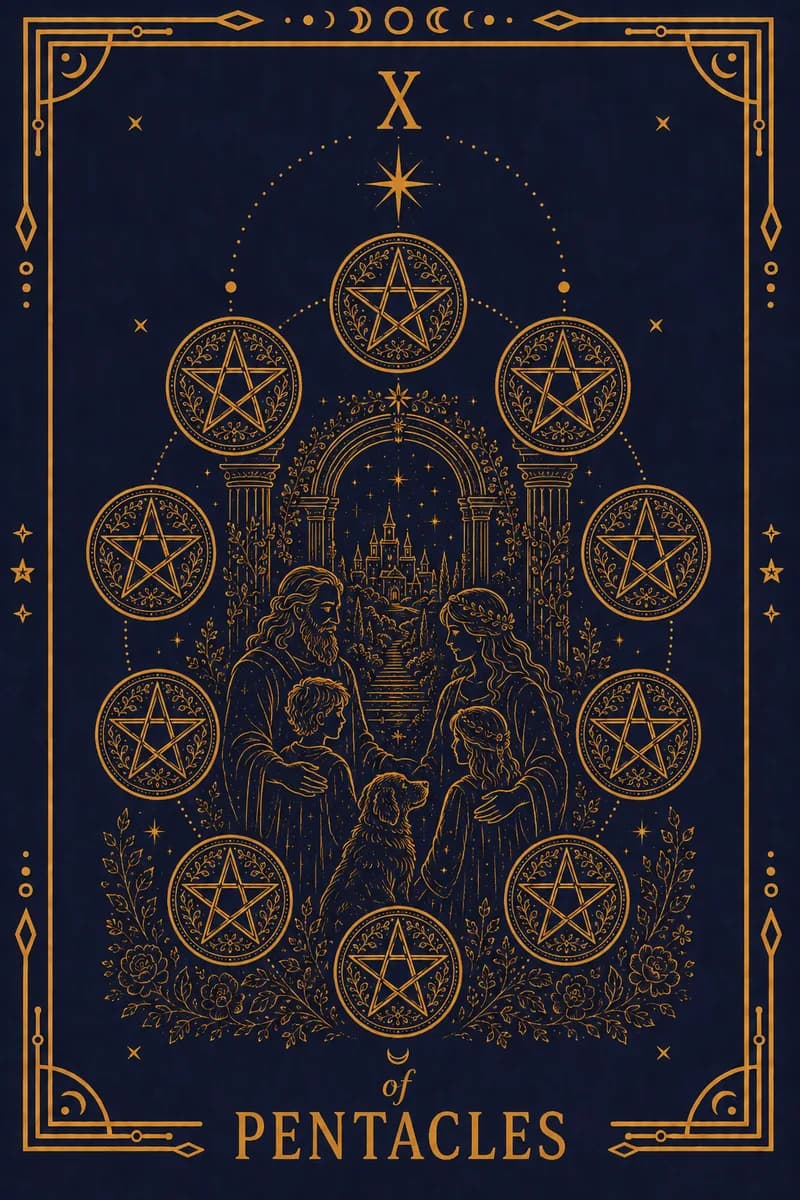
An old man in a patterned robe sits with two dogs while a couple and a child stand under an archway of the family house. The pentacles are arranged as the Tree of Life. Only the dogs and the old man notice each other; nobody else is looking at him.
Golden Dawn titled it Wealth. The Kabbalistic Tree of Life arrangement of the ten pentacles is the deck's most explicit Qabalistic reference outside the majors.
Written by Memento Arcana against the Rider-Waite-Smith deck and the Golden Dawn attributions it was built on. No part of it was generated by a language model. Last updated 17 August 2026.
Where traditions disagree about this card, the page says so rather than picking one quietly. How we write these, and our sources.
How Ten of Pentacles has actually shown up for other readers.
Nothing here yet. Be the first to say how this card has landed for you.
Guides to reading this card alongside the other 77.
Seventy-eight cards is a lot to memorise and you do not have to. The structure that turns most of the deck into logic, and the habit that does the rest.
Two cards together mean more than two cards apart. A four-step method: dominant card, elements, the tension between them, then back to your question.
The 22 majors are the themes you do not choose. The 56 minors are daily life. What each half does, and what it means when one dominates a reading.