The Lovers - Unisex Tee
From £17.95
View item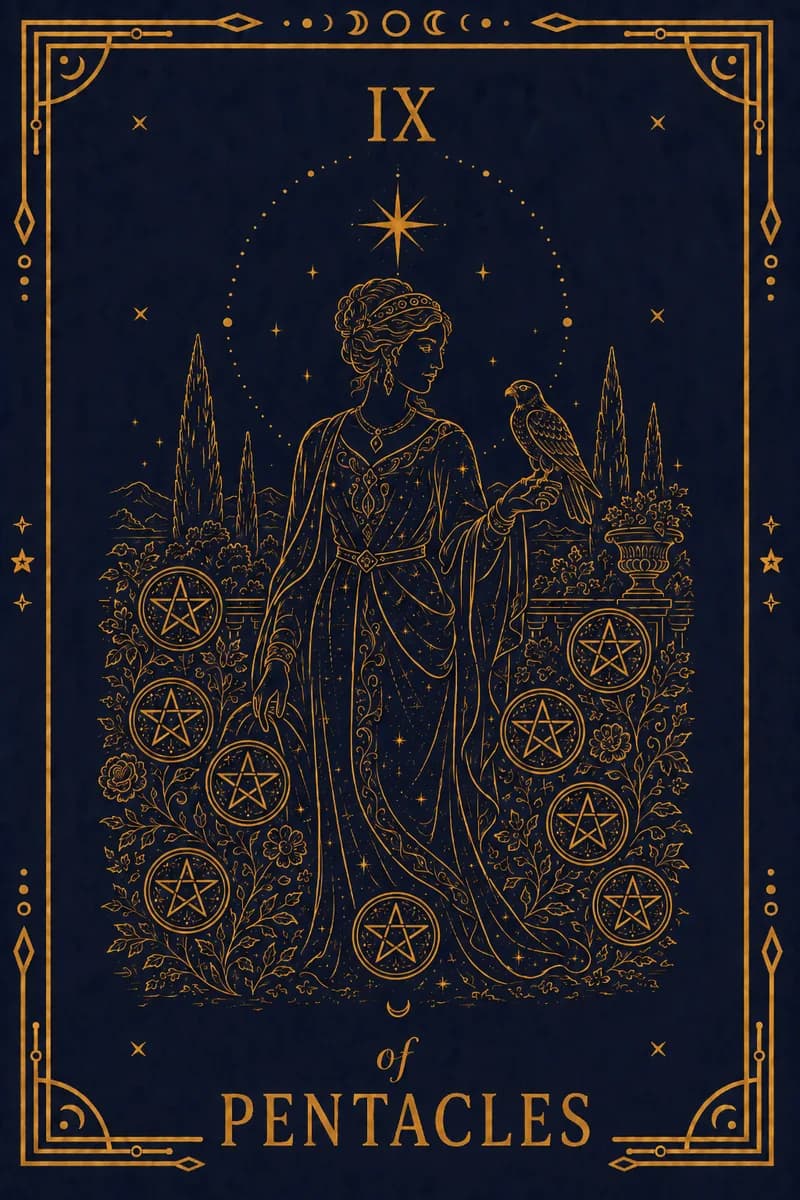 Nine of Pentacles
Pentacles · Number 9
The Nine is self-made comfort: independence, refinement, a life built alone and enjoyed alone. It is the reward of the Eight's discipline, and **the card is emphatic that the solitude here is chosen rather than imposed.** The falcon on her gloved hand is hooded, and that is the detail everything turns on. Her own wildness is trained and under control rather than absent. A snail crosses the ground beside her, slow and carrying its own house. Both are Smith additions and both say the same thing: this abundance is the result of discipline rather than fortune.
Affirmation
“I built this, and I am allowed to enjoy it.”
The Nine is self-made comfort: independence, refinement, a life built alone and enjoyed alone.
It is the reward of the Eight's discipline, and the card is emphatic that the solitude here is chosen rather than imposed.
The falcon on her gloved hand is hooded, and that is the detail everything turns on. Her own wildness is trained and under control rather than absent. A snail crosses the ground beside her, slow and carrying its own house. Both are Smith additions and both say the same thing: this abundance is the result of discipline rather than fortune.
Financial independence, self-sufficiency, earned luxury. Enjoy what you have built.
You do not need anybody's permission or participation, which is the card's most freeing claim and the one people find hardest to accept about themselves.
In an advice position it says spend some of it, on yourself, now. The Nine of Pentacles has no patience with a life of accumulation that is never drawn down, and it is the only card in the suit that treats pleasure as the point.
Dependence, or independence that has hardened into isolation.
The second is the more interesting. Self-sufficiency is a defence as well as an achievement, and a person who needs nobody has usually learned that somewhere. The card reversed asks whether the walls around the vineyard are still doing a job.
Also read for living beyond means, and for success that required giving up more than it returned, which is a real and quiet outcome that nobody puts on a CV.
Contentment alone, and the card means contentment rather than resignation.
It is one of the few cards in the deck that describes being single as a good outcome rather than an interval, and the tradition is unusually firm about it. A life that works on its own is not a waiting room.
Within a relationship it describes two independent people rather than two needy ones: two lives that function separately and have been chosen to be shared, which is a different structure from two halves.
Reversed, loneliness rather than solitude. The distinction is whether the door is open, and only the person inside can say.
As somebody's feelings, it reads as self-possessed and unhurried: interested, and not organising their life around the answer.
Self-employment, a mature career, work that no longer requires proving.
It describes the stage where competence is established and does not need demonstrating in every meeting, and it favours working for yourself, consultancy, and any arrangement where the terms are yours.
Reversed, over-reliance on a job for identity, which is the specific risk of a career this successful. The vineyard is walled, and a life entirely inside it is smaller than it looks.
Financial independence achieved. Wealth that came from work rather than luck.
The card is at ease with money in a way the Four is not: it has been earned, it is sufficient, and it is being enjoyed rather than guarded.
Its one caution is about the ratchet. Comfort establishes a standard, and the standard becomes a requirement, which is how a secure position turns back into an anxious one without the numbers changing.
Self-sufficiency, and pleasure in what you have made without needing it witnessed.
The hooded falcon is the spiritual content: appetite and wildness trained rather than killed, kept close and released deliberately. That is a more interesting model than renunciation and an older one.
Associated with practice done alone and unreported, and with the finding that the version nobody sees is usually the honest one.
Good health from long-maintained habits: the compound interest of care.
Read as reflection rather than diagnosis, the card describes a body that is the product of years of ordinary decisions rather than of any intervention. Nothing dramatic was done and the result is visible in middle age.
Its risk is the isolation reading. Solitude is good for a life and poor for health at the extremes, and the evidence on that is reasonably clear. Anything persistent belongs with a doctor, and this card describes the type of person who prefers to manage it alone.
For reflection and entertainment. Not medical, legal, or financial advice.
A woman in an embroidered robe stands in a walled vineyard, a hooded falcon on her gloved hand. The hood is the detail: her own wildness is trained and under control, not absent. A snail crosses the ground, slow and self-housed.
Golden Dawn called it Material Gain. The falcon's hood and the snail are both Smith additions and both point the same way. This abundance is the result of discipline, not fortune.
Written by Memento Arcana against the Rider-Waite-Smith deck and the Golden Dawn attributions it was built on. No part of it was generated by a language model. Last updated 17 August 2026.
Where traditions disagree about this card, the page says so rather than picking one quietly. How we write these, and our sources.
How Nine of Pentacles has actually shown up for other readers.
Nothing here yet. Be the first to say how this card has landed for you.
Browse Our Store
Tarot decks, journals, prints and apparel, shipped worldwide.
Guides to reading this card alongside the other 77.
Seventy-eight cards is a lot to memorise and you do not have to. The structure that turns most of the deck into logic, and the habit that does the rest.
Two cards together mean more than two cards apart. A four-step method: dominant card, elements, the tension between them, then back to your question.
The 22 majors are the themes you do not choose. The 56 minors are daily life. What each half does, and what it means when one dominates a reading.