
How to Learn Tarot Card Meanings Without Memorising
Seventy-eight cards is a lot to memorise and you do not have to. The structure that turns most of the deck into logic, and the habit that does the rest.
 Ten of Swords
Swords · Number 10
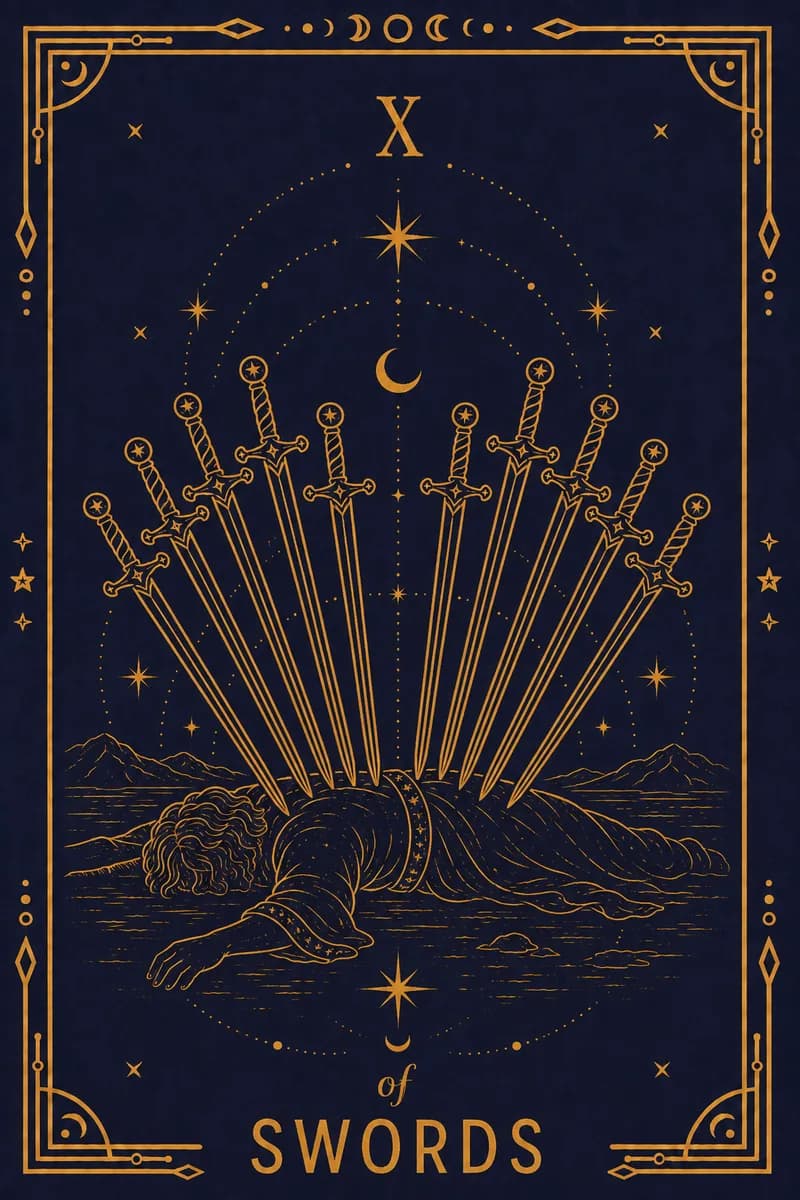
The Ten is rock bottom: total defeat, betrayal, the end of something in the worst available way. Its one mercy is finality. **Ten swords is as many as there are**, and the sun is rising at the edge of the frame. The practical reading is that ten is as many as there are. Nothing further can be added to this, which makes it the one card in the suit that cannot get worse. That is a thin comfort and it is a real one.
Affirmation
“This is the bottom. The bottom is also a floor.”
The Ten is rock bottom: total defeat, betrayal, the end of something in the worst available way.
Its one mercy is finality. Ten swords is as many as there are, and the sun is rising at the edge of the frame.
The practical reading is that ten is as many as there are. Nothing further can be added to this, which makes it the one card in the suit that cannot get worse. That is a thin comfort and it is a real one.
Ruin, betrayal, an ending with nothing salvageable. It is over.
The card does not soften this and neither should a reading of it. Whatever this refers to has finished, and finished badly, and the honest response is to say so.
What it does insist on is direction. It cannot get worse from here, which is a small thing to offer and is the only true thing available on the day.
Recovery beginning, survival, getting up.
Or refusing to let something be over: reliving a defeat that has already finished, which keeps the swords in place long after anybody else has moved on.
The recovery reading is more common and is worth reading warmly. Survival is the achievement here, and people who have been through what this card describes rarely give themselves credit for the fact that they are still upright.
A relationship ending badly. Betrayal, and an ending with no dignity available in it.
The card is honest that some endings are simply bad. Not everything can be handled well, and the tradition does not require anybody to find the growth in it while it is happening.
Reversed, slow recovery, or an inability to stop rehearsing what happened. The rehearsal is normal for a while and becomes its own problem eventually, and there is no fixed point at which that changes.
As somebody's feelings, it reads as finished and painful. This is the deck's bluntest answer in this position and a reader who softens it is not helping.
Job loss, a project collapsing, being undermined comprehensively. A definitive professional ending.
It describes the version that is not recoverable in place: the role that is gone, the reputation damaged in that organisation, the thing that cannot be fixed by working harder.
The practical reading is unglamorous and correct. Nothing has to be decided this week, and the first thing to do after this card is usually to make sure you have eaten and slept rather than to plan a comeback.
Serious financial loss. Bottoming out.
The only direction available is up, which is not much comfort on the day and is worth knowing on the following one.
If this is where you are: debt advice charities deal with exactly this every day and they are free. Nothing about the situation is unusual to them, and the shame that stops people calling is the single biggest thing standing between this card and its reversal.
The end of a version of yourself: nothing left to defend.
Some traditions consider that the precondition for everything that follows, and they are describing the same experience from the far side of it. That reading is legitimate and it is useless as consolation in the moment.
Associated with the point at which somebody stops trying to hold a self together, and with the observation that the dawn in the picture is at the edge rather than overhead.
Collapse, exhaustion, hitting a limit.
Read as reflection rather than diagnosis, and with the plainest note on the site. Get help. This card describes the point past which managing alone has stopped being possible, and the correct response is a person rather than a plan.
A GP, an urgent appointment, or someone you trust. If you are in crisis or thinking about ending your life, contact emergency services or a crisis line immediately: in the UK, Samaritans on 116 123, free, any time of day or night. This card is not a prediction of anything, and it is a reasonable prompt to make that call.
For reflection and entertainment. Not medical, legal, or financial advice.
A figure lies face down with ten swords in his back under a black sky, and a clear yellow dawn breaks along the horizon. The water is completely still. His right hand is held in a blessing gesture.
Golden Dawn titled it Ruin. The dawn is Smith's addition and is the entire reason the card is survivable; the blessing gesture is Waite's, and he never explained it.
Written by Memento Arcana against the Rider-Waite-Smith deck and the Golden Dawn attributions it was built on. No part of it was generated by a language model. Last updated 17 August 2026.
Where traditions disagree about this card, the page says so rather than picking one quietly. How we write these, and our sources.
How Ten of Swords has actually shown up for other readers.
Nothing here yet. Be the first to say how this card has landed for you.
Guides to reading this card alongside the other 77.
Seventy-eight cards is a lot to memorise and you do not have to. The structure that turns most of the deck into logic, and the habit that does the rest.
Two cards together mean more than two cards apart. A four-step method: dominant card, elements, the tension between them, then back to your question.
The 22 majors are the themes you do not choose. The 56 minors are daily life. What each half does, and what it means when one dominates a reading.