
How to Learn Tarot Card Meanings Without Memorising
Seventy-eight cards is a lot to memorise and you do not have to. The structure that turns most of the deck into logic, and the habit that does the rest.
 Ten of Wands
Wands · Number 10
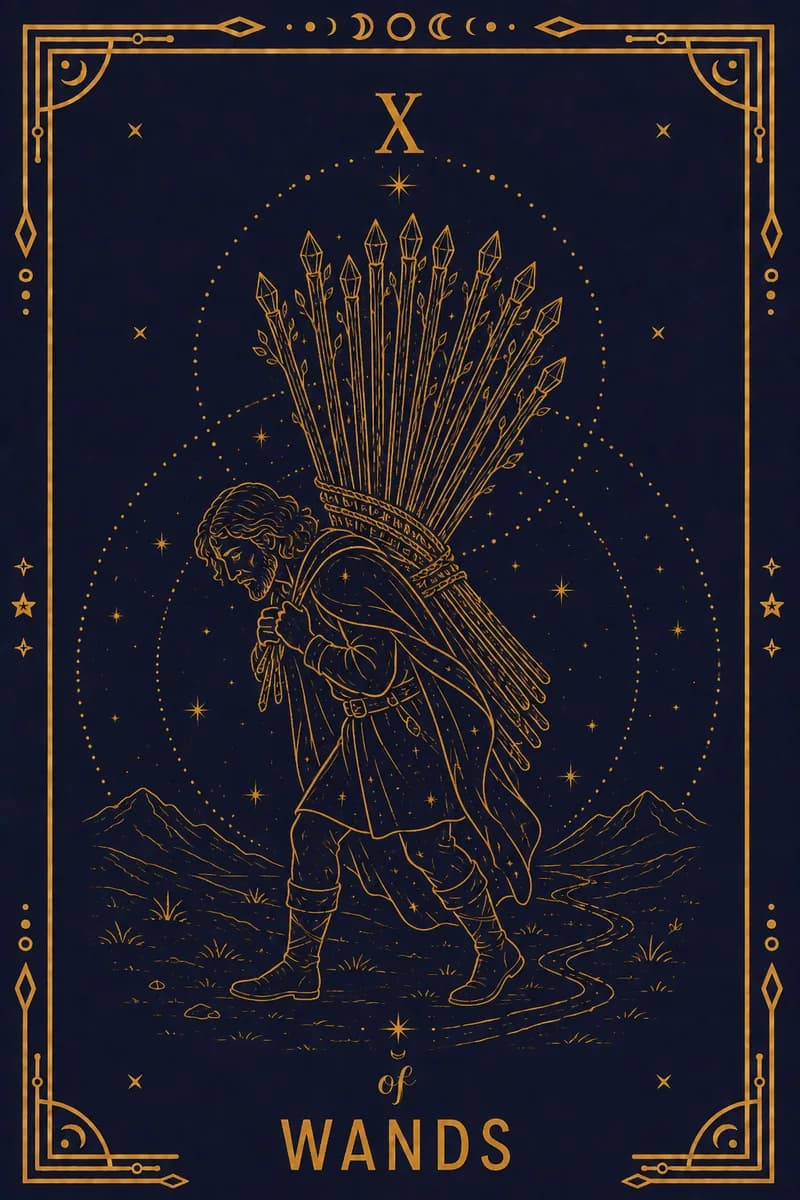
The Ten is overload. The suit's fire has become weight. Every commitment taken on, still being carried, all at once. Success has turned into burden, and the card asks what could be put down. **He is nearly home and cannot see it**, because what he is carrying is in the way. That is the whole card: the load is not the obstacle to arriving, it is the reason he does not know he has nearly arrived.
Affirmation
“I put down what was never mine to carry.”
The Ten is overload. The suit's fire has become weight.
Every commitment taken on, still being carried, all at once. Success has turned into burden, and the card asks what could be put down.
He is nearly home and cannot see it, because what he is carrying is in the way. That is the whole card: the load is not the obstacle to arriving, it is the reason he does not know he has nearly arrived.
Overwhelm, overcommitment, carrying more than is yours.
The goal is in sight and you are too loaded to enjoy reaching it, which is the particular cruelty of this card: nothing has gone wrong, and that is why it is so hard to justify complaining.
In an advice position it is direct: delegate or drop something. Not reorganise, not work harder, not get up earlier. Reduce the load.
Putting the load down, delegating, or refusing to take on more.
The good reading is genuinely good and usually follows a long upright period: somebody finally saying no, or asking, or letting a thing fail that was never theirs.
Sometimes collapse under the weight, or offloading responsibility onto somebody else unfairly, which is the same relief obtained at another person's expense.
A relationship that has become a chore, or one person carrying all the emotional labour.
That second reading is the one that matters and it is worth being precise about. The labour in question is invisible: remembering birthdays, noticing when something is wrong, managing the calendar, keeping in touch with both families. It is real work and it is very rarely counted.
Reversed, the load finally shared, which usually requires it to be named first, because the person carrying it has generally not mentioned it and the other person has genuinely not noticed.
As somebody's feelings, it reads as overwhelmed rather than uninterested: this person has nothing spare at the moment, and it is probably not about you.
Too much work, no capacity, responsibility without support.
It is the card of the person who is good at their job and has been given everybody else's as a reward. Saturn in Sagittarius: an expansive appetite meeting a hard limit.
Reversed, boundaries set, or a resignation. The practical reading upright is that this does not resolve by improving your own efficiency, because efficiency is what caused it.
Financial burden, debt carried alone, working purely to service obligations.
The card describes the shape rather than the sum: an income that is entirely spoken for before it arrives, and a life organised around meeting commitments made some time ago.
Its counsel is the same as everywhere else on this card. Something has to come off the pile, and free debt advice is very good at identifying which.
Discerning what is genuinely yours to carry, and most of this is not.
The card sits against the versions of duty that treat load as virtue. Carrying more than you were given is not service; it is usually an identity, and it is expensive.
Associated with the practice of setting things down deliberately, and with the observation that the person who cannot put anything down is not being asked to carry it by anybody in particular.
Physical and mental exhaustion, and back and shoulder strain.
The card is unusually literal, and the traditional reading of it as a body carrying too much is worth taking at face value: this is the posture in the picture.
Read as reflection rather than diagnosis, it describes stress with a clear bodily cost, and its instruction is reduction rather than recovery. Rest applied to an unchanged load is absorbed by the load. Anything that has become persistent, particularly back or shoulder pain, belongs with a doctor or a physiotherapist rather than being carried further.
For reflection and entertainment. Not medical, legal, or financial advice.
A man carries ten staves in a bundle so wide he cannot see over it. The town he is walking toward is close. He is nearly home and cannot see it.
Golden Dawn called it Oppression. Waite specifically read it as the burden that comes with success rather than instead of it, which is why the destination is deliberately drawn within reach.
Written by Memento Arcana against the Rider-Waite-Smith deck and the Golden Dawn attributions it was built on. No part of it was generated by a language model. Last updated 17 August 2026.
Where traditions disagree about this card, the page says so rather than picking one quietly. How we write these, and our sources.
How Ten of Wands has actually shown up for other readers.
Nothing here yet. Be the first to say how this card has landed for you.
Guides to reading this card alongside the other 77.
Seventy-eight cards is a lot to memorise and you do not have to. The structure that turns most of the deck into logic, and the habit that does the rest.
Two cards together mean more than two cards apart. A four-step method: dominant card, elements, the tension between them, then back to your question.
The 22 majors are the themes you do not choose. The 56 minors are daily life. What each half does, and what it means when one dominates a reading.