
How to Learn Tarot Card Meanings Without Memorising
Seventy-eight cards is a lot to memorise and you do not have to. The structure that turns most of the deck into logic, and the habit that does the rest.
 Seven of Cups
Cups · Number 7
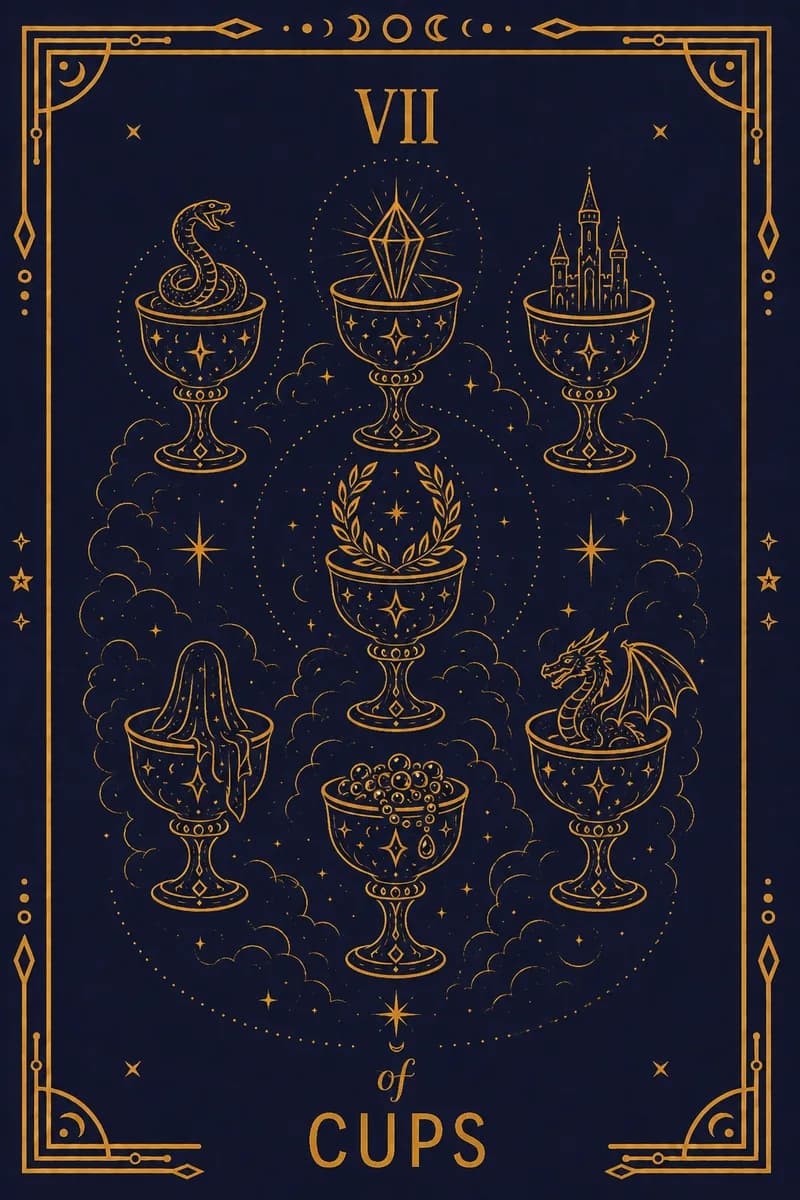
The Seven is too many options and no way to tell which are real. Fantasy, projection and genuine possibility, all presented identically. The card is not against choosing. **It is against choosing while dreaming**, which is a narrower and more useful objection. Only one of the seven cups is covered, and the shroud is the point. The most attractive option is the one you cannot see, because you have supplied its contents yourself.
Affirmation
“I decide with my eyes open.”
The Seven is too many options and no way to tell which are real. Fantasy, projection and genuine possibility, all presented identically.
The card is not against choosing. It is against choosing while dreaming, which is a narrower and more useful objection.
Only one of the seven cups is covered, and the shroud is the point. The most attractive option is the one you cannot see, because you have supplied its contents yourself.
Choice overload, wishful thinking, illusion. Options that look better than they are, with one that is genuinely good hidden among them.
The hidden good option matters. This is not a card that says everything on offer is worthless; it says the presentation is unreliable and the sorting has not been done.
In an advice position it asks for something specific and dull: investigate one of them properly rather than imagining all seven. The card is quite clear that the imagining is the pleasurable part and the reason nothing progresses.
Clarity arriving. Cutting through to the real option and committing to it, usually with some relief.
Or, less happily, retreating into fantasy entirely, where the options have stopped being candidates and become a place to live.
The useful test the tradition offers is time. A choice that has been open for a long time is not being considered, and the card reversed is often the point at which somebody notices how long it has been.
Idealising somebody, or too many options preventing any real connection.
The idealising reading is the sharper of the two and is about the shrouded cup: what is being loved is a version supplied by the person doing the loving, and it does not survive contact. That is not a comment on the other person, who is usually unaware of the part they are playing.
The second is a genuinely modern situation and the card handles it well: plenty of possibility and no actual connection, because a shortlist that never closes is not a shortlist.
Reversed, seeing a person as they actually are, which is either a loss or the beginning of something real and is frequently both.
As somebody's feelings, it reads as unclear and probably idealised: this person may be feeling a great deal about an idea of you rather than about you, and it is not a stable position for either of you.
Too many directions, none committed to. Daydreaming about work instead of doing any.
It is the card of the person with four business ideas, none started, each of which is more appealing than the one they began last month. The tradition is unsentimental: the appeal is inversely proportional to how much is known about it.
Reversed, a decision finally made. The practical reading upright is to pick the one with the least glamour and the most information, and to accept that the others were partly a way of not starting.
Get-rich schemes and financial fantasy. Do the arithmetic before believing the pitch.
The card is associated with the opportunity that is explained rather than documented, and with returns described in a conversation rather than written down. The seven cups are a good picture of a portfolio of intentions.
Its one instruction is worth repeating plainly: anything that cannot survive a spreadsheet was never an investment.
Discernment: distinguishing genuine vision from the mind's preferred stories. Scorpio insists you look at the difference.
Every contemplative tradition that takes inner experience seriously also builds a test for it, and this card is where that requirement sits in the deck. Material arriving from inside is not self-authenticating.
Associated with the practice of holding an insight for a while before acting on it, on the grounds that the ones that are real are still there in a month.
Escapism and its usual vehicles, and confused symptoms with more than one plausible explanation.
Read as reflection rather than diagnosis, the card describes a picture that has not resolved: several possible accounts, none confirmed, and a strong temptation to settle on whichever is most or least frightening.
Its practical counsel is the same as The Moon's and is worth repeating: write down what actually happens and when, and take the record to a doctor. A card cannot sort seven possibilities, and neither can an internet search.
For reflection and entertainment. Not medical, legal, or financial advice.
A silhouetted figure faces seven cups in cloud, each holding something different: a face, a shrouded glowing figure, a snake, a castle, jewels, a laurel, a dragon. Only one is covered, and the shroud is the point.
Golden Dawn titled it Illusory Success. The seven contents are usually read as fame, love/mystery, temptation, escape, wealth, achievement and fear, though Waite left the identifications deliberately unfixed.
Written by Memento Arcana against the Rider-Waite-Smith deck and the Golden Dawn attributions it was built on. No part of it was generated by a language model. Last updated 17 August 2026.
Where traditions disagree about this card, the page says so rather than picking one quietly. How we write these, and our sources.
How Seven of Cups has actually shown up for other readers.
Nothing here yet. Be the first to say how this card has landed for you.
Guides to reading this card alongside the other 77.
Seventy-eight cards is a lot to memorise and you do not have to. The structure that turns most of the deck into logic, and the habit that does the rest.
Two cards together mean more than two cards apart. A four-step method: dominant card, elements, the tension between them, then back to your question.
The 22 majors are the themes you do not choose. The 56 minors are daily life. What each half does, and what it means when one dominates a reading.