
How to Learn Tarot Card Meanings Without Memorising
Seventy-eight cards is a lot to memorise and you do not have to. The structure that turns most of the deck into logic, and the habit that does the rest.
 Eight of Cups
Cups · Number 8
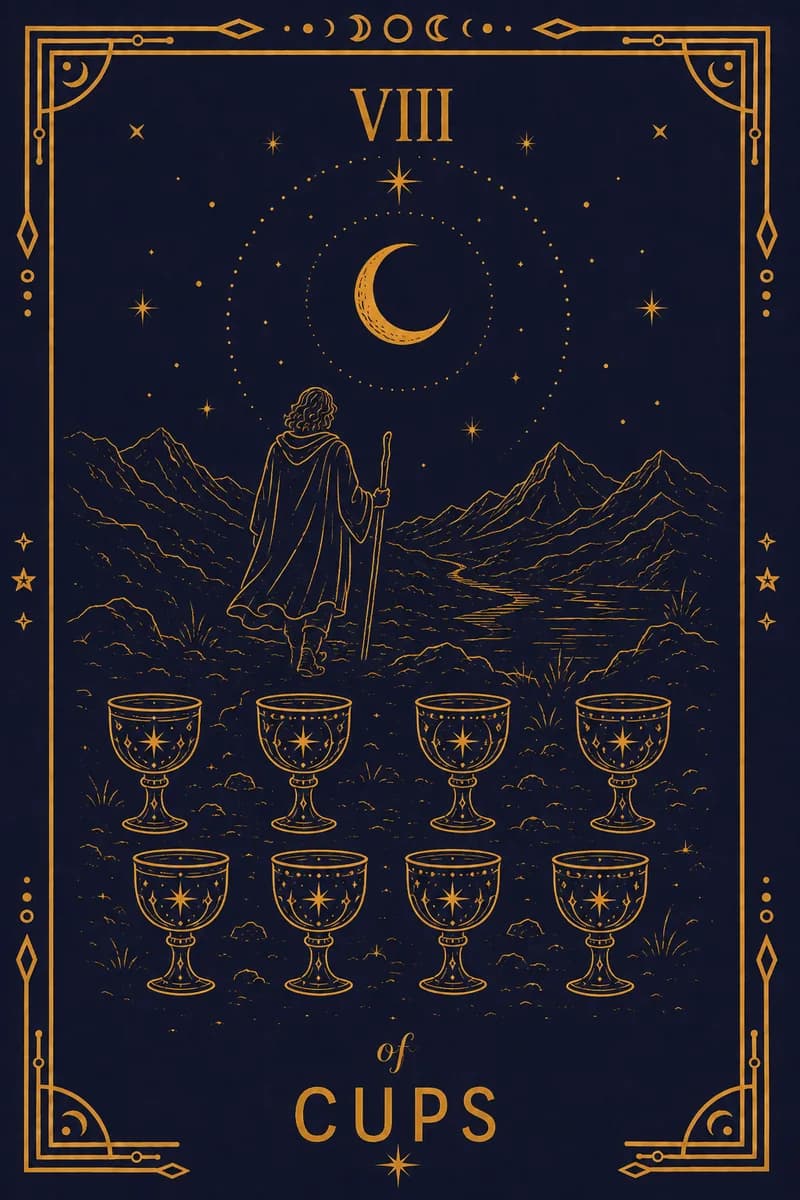
The Eight is walking away from something that is not broken. Nothing failed. It simply stopped being enough, and the honest response is to leave rather than to stay and pretend. **The cups are stacked neatly and none of them is knocked over**, which is the detail that separates this card from every other departure in the deck. There is a visible gap in the stack. Something was missing rather than ruined, and the figure has decided that the gap matters more than the eight that are present. The moon eclipses the sun above him, and he does not look back.
Affirmation
“I can leave something good because it is not mine.”
The Eight is walking away from something that is not broken.
Nothing failed. It simply stopped being enough, and the honest response is to leave rather than to stay and pretend. The cups are stacked neatly and none of them is knocked over, which is the detail that separates this card from every other departure in the deck.
There is a visible gap in the stack. Something was missing rather than ruined, and the figure has decided that the gap matters more than the eight that are present. The moon eclipses the sun above him, and he does not look back.
Departure, a search for deeper meaning, leaving something that has been outgrown. Difficult and correct.
The card is about integrity rather than escape, and the tradition draws that line carefully: leaving because a thing is wrong for you is this card, and leaving because something is hard is a different one.
In an advice position it gives permission that people rarely give themselves: you are allowed to leave something good. No further justification is required, and the card is clear that waiting for one produces years rather than a decision.
Staying too long out of guilt or fear. Or drifting away without ever deciding to, which costs both people more than a departure would.
Sometimes returning to what you left, which the card treats as a real option rather than a failure. Not every walking away turns out to have been right, and the tradition is unusually undogmatic here.
The reading worth watching is the exit that is being performed rather than taken: talking about leaving for years is its own arrangement, and it is more comfortable than either staying or going.
Leaving a relationship that is fine and not right.
That is the whole card and it is one of the hardest positions there is, precisely because nothing has gone wrong. There is no incident to point at, nobody has behaved badly, and every explanation sounds inadequate out loud. The card's contribution is to say that this is a sufficient reason and that the absence of a story does not invalidate it.
Reversed, staying out of obligation, or going back. Both are treated as genuine options rather than as failures, which is unusual and correct: people do return, and some of those returns work.
As somebody's feelings, it reads as somebody who has already begun to leave, emotionally, whatever they are saying. That is a hard answer and it is what the card says.
Resigning from a good job that no longer means anything. A career change towards meaning over money.
It is specifically the card for leaving something that other people envy, and for the conversations that follow, in which nobody understands the decision. The tradition takes the side of the person leaving.
The practical reading is that the thing being sought is not available where you are, and no amount of adjustment to the current role will produce it. It is a poor card for negotiating a change internally and a strong one for going.
Walking away from money for something that matters more, and the financial cost of integrity.
The card does not pretend the cost is small. Saturn's presence here is about the term: this is a decision whose price is paid over years and whose return is not measured in money at all.
Reversed, staying for the money and calling it something else. The card asks only that the trade be named accurately, and it does not insist anybody make the other choice.
The pilgrimage card: leaving comfort deliberately in search of something you cannot name yet.
That inability to name it is central. The figure is not walking towards a specified destination, and the tradition treats a search with clear success criteria as a different activity altogether.
Associated with renunciation in its practical form, and with the observation that most traditions begin with somebody leaving somewhere comfortable for reasons they could not fully explain at the time.
Leaving behind a habit or an environment that is quietly harming you. Emotional exhaustion driving a change.
Read as reflection rather than diagnosis, its most useful application is to the situation nobody would call a crisis: the job, the house, the arrangement that is not causing an illness and is steadily costing something.
The card is also associated with stopping something that was never dramatic enough to justify stopping, which is a real and underrated health decision. Anything physical, and any exhaustion that does not lift when the situation changes, belongs with a doctor.
For reflection and entertainment. Not medical, legal, or financial advice.
A figure walks away over rocky ground toward mountains, leaving eight cups stacked with a visible gap. The moon eclipses the sun above. He does not look back, and the cups are not knocked over.
Golden Dawn titled it Abandoned Success, an unusually precise name. The gap in the stack, rather than any damage, is what tells you something was missing rather than ruined.
Written by Memento Arcana against the Rider-Waite-Smith deck and the Golden Dawn attributions it was built on. No part of it was generated by a language model. Last updated 17 August 2026.
Where traditions disagree about this card, the page says so rather than picking one quietly. How we write these, and our sources.
How Eight of Cups has actually shown up for other readers.
Nothing here yet. Be the first to say how this card has landed for you.
Guides to reading this card alongside the other 77.
Seventy-eight cards is a lot to memorise and you do not have to. The structure that turns most of the deck into logic, and the habit that does the rest.
Two cards together mean more than two cards apart. A four-step method: dominant card, elements, the tension between them, then back to your question.
The 22 majors are the themes you do not choose. The 56 minors are daily life. What each half does, and what it means when one dominates a reading.