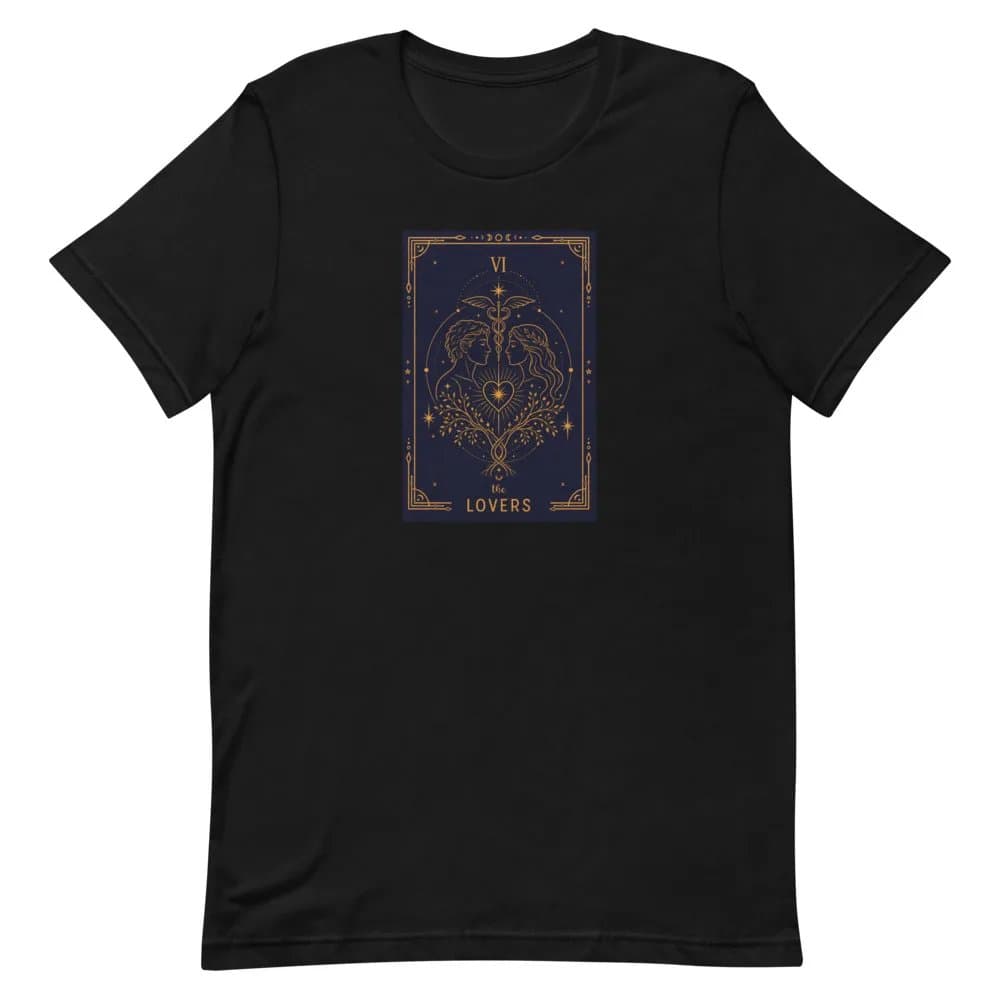
The Lovers - Unisex Tee
From £17.95
View item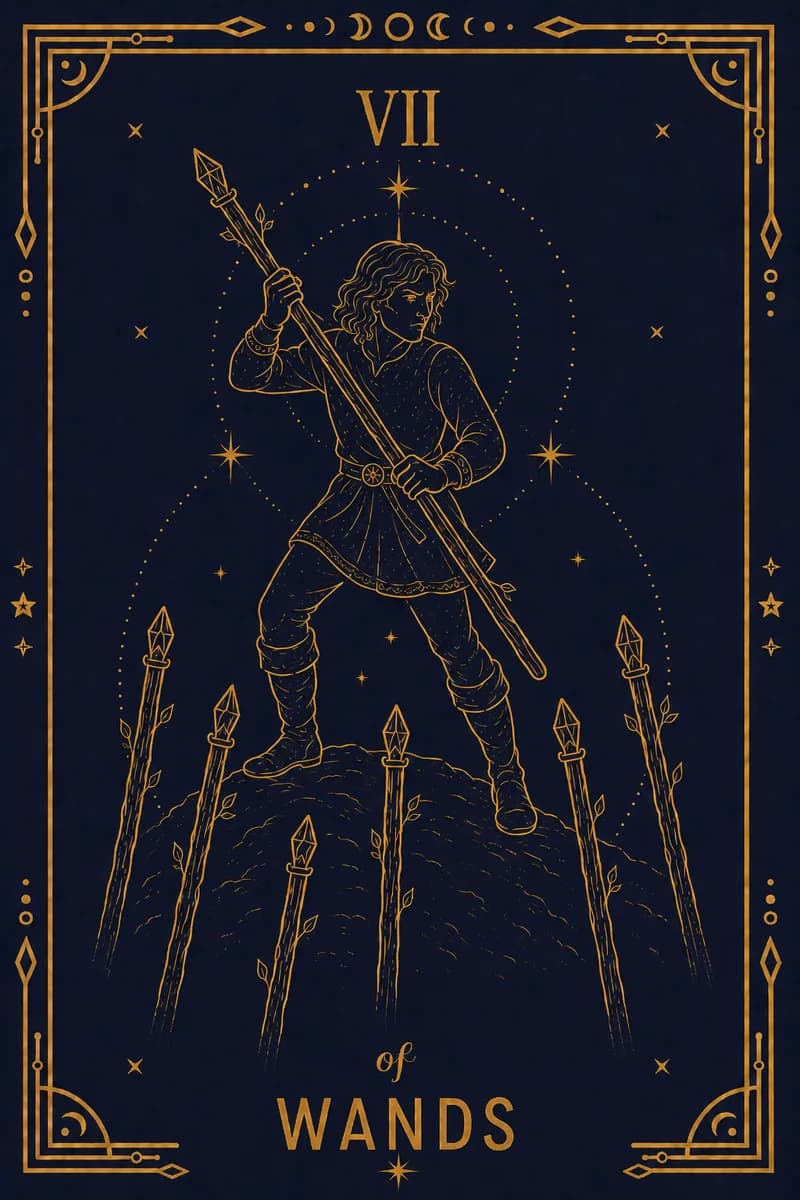 Seven of Wands
Wands · Number 7
The Seven is defending what you won. Success attracts challenge, and this card is the point where you find out whether you will hold the position or hand it over. **He is winning, and he cannot see who he is fighting.** The six staves rise from below the frame with nobody attached to them, which is the honest shape of most defended positions: the pressure is real and its source is largely assumed.
Affirmation
“I hold the ground I earned.”
The Seven is defending what you won.
Success attracts challenge, and this card is the point where you find out whether you will hold the position or hand it over.
He is winning, and he cannot see who he is fighting. The six staves rise from below the frame with nobody attached to them, which is the honest shape of most defended positions: the pressure is real and its source is largely assumed.
Standing your ground. Defending a boundary, a position, a piece of work.
You have the high ground and the advantage. Use it and do not apologise, which is the instruction people struggle with when the challenge comes from somebody they like.
Its realism is the good part: the defender is not prepared and is not losing. The card does not require you to feel ready in order to hold something.
Overwhelmed by the number of challenges, or giving up a position you had earned.
The second is worth distinguishing from a decision. Conceding because it is no longer worth defending is fine; conceding because the defending is exhausting is the reversal, and the two feel identical on the day.
Also read for defensiveness where no attack was made, which is the version everybody around the person can see and they cannot.
Defending a relationship against outside pressure, or defending your needs inside one.
The second is the more useful reading and the less discussed. Stating a need repeatedly to somebody who keeps not hearing it is exactly the posture in the picture, and it is exhausting in the same way.
Reversed, exhaustion from constantly having to justify yourself. That is a real state, it accumulates invisibly, and the card is direct that a position requiring perpetual defence is worth examining rather than simply holding harder.
As somebody's feelings, it reads as guarded and committed at once: this person is protecting something, and you may be what they are protecting.
Competition for your role, your idea, your credit. Hold it.
The card is confident about the outcome and clear about the cost. Defending a position at work is winnable and it consumes the energy that would otherwise go into the work itself.
Reversed, burnout from perpetual defence, or conceding too early. The practical question is whether the challenge is a phase or the shape of the job, because those need different answers.
Protecting assets or income against a claim. Standing firm on price.
The pricing reading is the most immediately useful: this is the card for not discounting, for holding a rate, and for declining to justify a fee that is already fair.
Reversed, a position defended at a cost exceeding its value, which is where a principle becomes an expensive hobby.
Conviction under pressure, and the difference between principle and stubbornness.
The card asks you to be honest about which one you are exercising, and it is genuinely difficult to tell from inside: both feel like integrity, and only one of them is responsive to evidence.
Associated with holding an unpopular position, and with the observation that the test is whether you could describe what would change your mind.
Immune response, resilience, fighting something off.
Read as reflection rather than diagnosis, the card describes a body under attack and coping: the run of minor illnesses, the recovery that is working, the period of holding on.
Reversed, defences worn down, which is the more common appearance and usually follows a long stretch of the upright. Repeated infections or a resilience that has visibly dropped is a reasonable thing to raise with a doctor rather than push through.
For reflection and entertainment. Not medical, legal, or financial advice.
A man on high ground fends off six staves rising from below. He cannot see who holds them. Notably, he is wearing mismatched shoes: he came to this fight in a hurry and improvised.
Golden Dawn titled it Valour. The mismatched footwear is one of Smith's small deliberate details, widely read as evidence that the defender was not prepared and is winning anyway.
Written by Memento Arcana against the Rider-Waite-Smith deck and the Golden Dawn attributions it was built on. No part of it was generated by a language model. Last updated 17 August 2026.
Where traditions disagree about this card, the page says so rather than picking one quietly. How we write these, and our sources.
How Seven of Wands has actually shown up for other readers.
Nothing here yet. Be the first to say how this card has landed for you.
Browse Our Store
Tarot decks, journals, prints and apparel, shipped worldwide.
Guides to reading this card alongside the other 77.
Seventy-eight cards is a lot to memorise and you do not have to. The structure that turns most of the deck into logic, and the habit that does the rest.
Two cards together mean more than two cards apart. A four-step method: dominant card, elements, the tension between them, then back to your question.
The 22 majors are the themes you do not choose. The 56 minors are daily life. What each half does, and what it means when one dominates a reading.