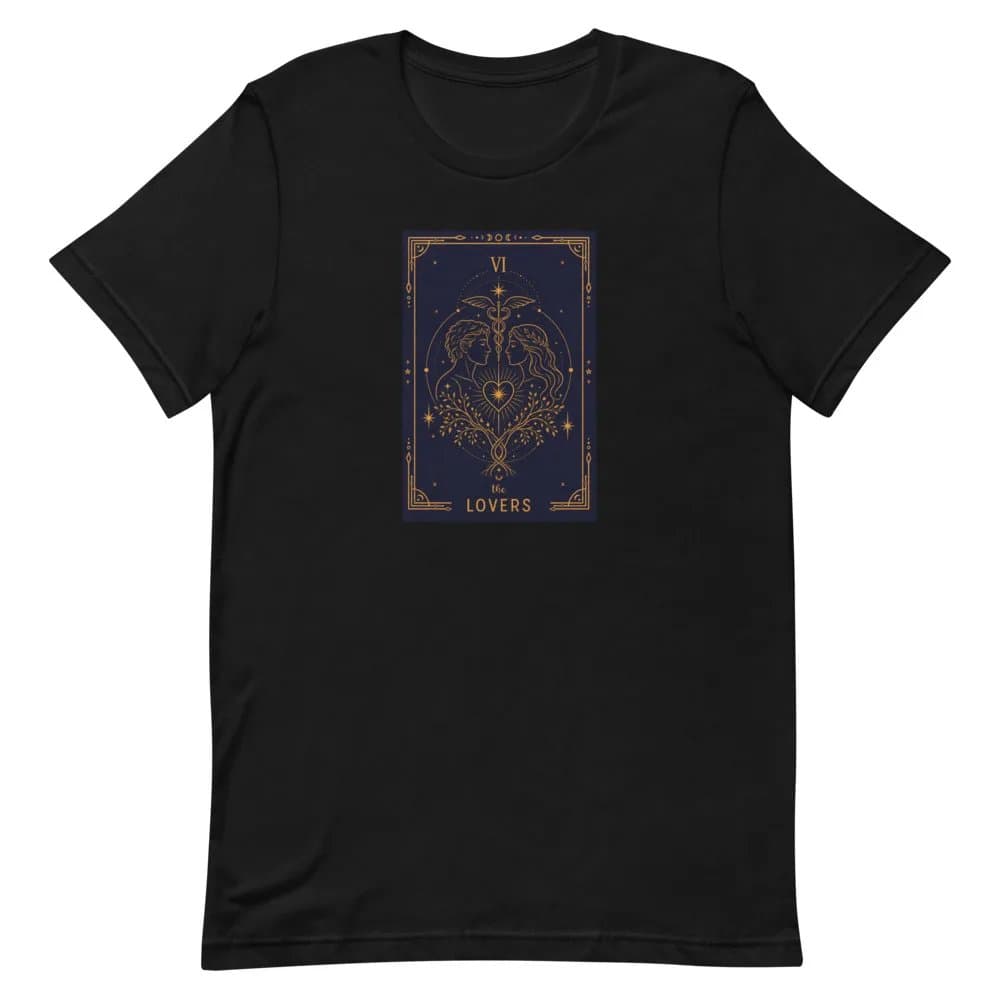
The Lovers - Unisex Tee
From £17.95
View item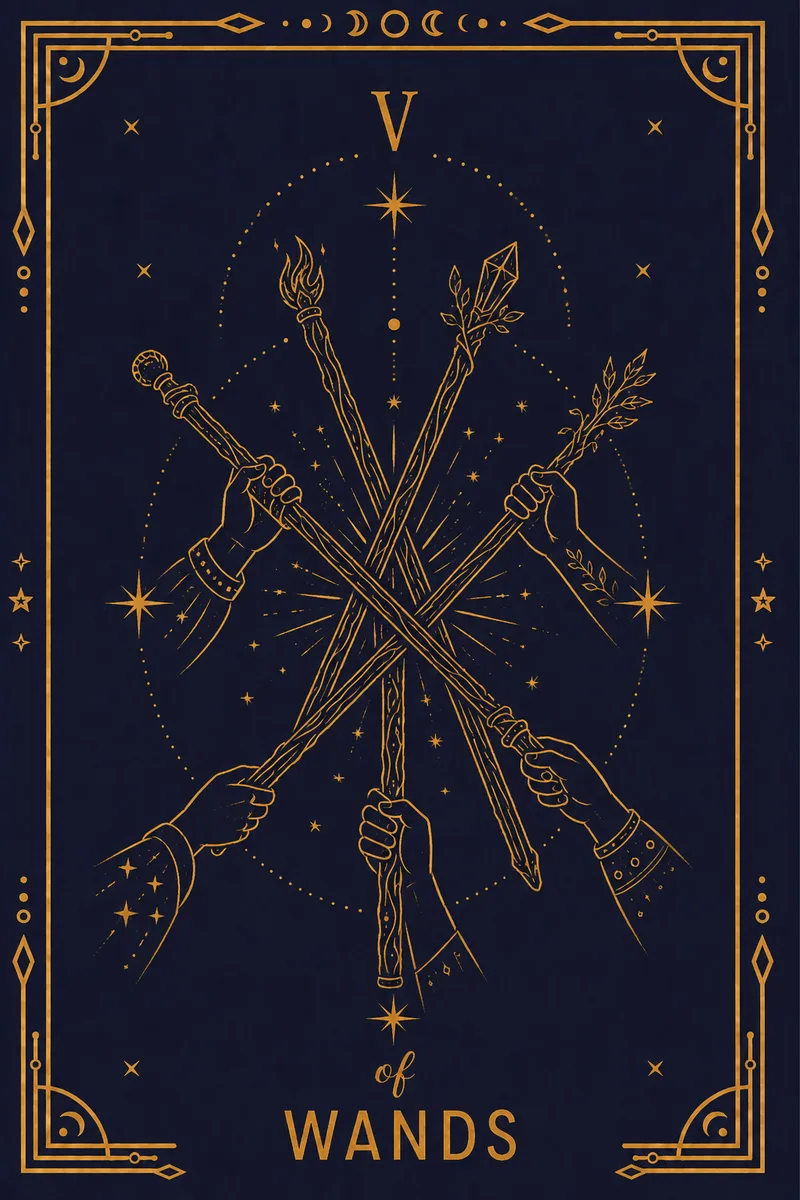 Five of Wands
Wands · Number 5
The Five is friction: competing energies, none of them evil, none of them coordinated. It is conflict without a villain, **which makes it more exhausting and more solvable than it feels.** The practical question it raises is whether anybody has actually said what is being contested. Most Five of Wands situations run on unstated assumptions about whose decision something is, and they continue until somebody names it out loud.
Affirmation
“I would rather have the real argument than the false peace.”
The Five is friction: competing energies, none of them evil, none of them coordinated.
It is conflict without a villain, which makes it more exhausting and more solvable than it feels.
The practical question it raises is whether anybody has actually said what is being contested. Most Five of Wands situations run on unstated assumptions about whose decision something is, and they continue until somebody names it out loud.
Competition, disagreement, everybody talking over each other.
Not a fight to the death: a scramble. That distinction changes what to do about it, because a scramble is a coordination problem rather than a moral one.
It is often productive if somebody imposes structure on it, which is the card's most useful practical note. Five people with different ideas is a resource until nobody chairs the meeting.
Conflict avoided rather than resolved, or genuinely ended.
The avoidance version is the more common and produces a quiet that everybody mistakes for agreement, until the same argument arrives attached to something trivial.
It can also mean inner conflict: competing impulses fighting internally instead of out loud, which is the same scrimmage with one participant and no possibility of a chair.
Petty friction and clashing needs. Nothing fundamental, and nothing being addressed either.
The card describes the accumulation of small unresolved things: the same disagreement about the same domestic subject, conducted with increasing efficiency and no progress.
What it points at is structure rather than feeling. Most of what this card describes is solved by two people deciding who does what, and almost none of it is solved by another round of the argument.
Reversed, tension defused, or resentment driven underground.
As somebody's feelings, it reads as agitated and unresolved: this person is contending with something, quite possibly not primarily about you.
A competitive environment, too many voices, unclear ownership.
The unclear ownership is usually the cause rather than the personalities. Where nobody has been told whose decision something is, capable people fight about it indefinitely and everybody blames the culture.
Reversed, the argument settled, or everybody quietly disengaging, which looks like peace and is the more expensive outcome.
Competing financial claims, disputes over shared money, market competition.
Associated with money that several people have a legitimate call on: an estate, a household, a business with partners, and with the scramble that follows when the terms were never set.
Its counsel is the same as everywhere else on this card: write down who gets what and who decides, and most of the friction stops.
Contending with yourself, and the value of a real argument over a false peace.
The card takes the position that unresolved internal conflict does not become resolved by being suppressed, and that traditions which prize serenity above honesty tend to produce a lot of quiet, tense people.
Associated with wrestling in the biblical sense, and with the observation that something worth believing survives being argued with.
Scattered energy, and stress from ongoing low-grade conflict.
Read as reflection rather than diagnosis, the card describes the cost of an environment that is never quite hostile and never quite settled: a workplace, a household, a family. It is well documented as more wearing over time than an acute crisis.
Reversed, tension released. The thing to notice is the duration rather than the intensity, and anything that has become physical belongs with a doctor.
For reflection and entertainment. Not medical, legal, or financial advice.
Five young men brandish staves in a disordered scrimmage. Nobody is injured, nobody is winning, and no two are fighting the same fight. The chaos is unserious and completely unproductive.
Golden Dawn titled it Strife, attributing Saturn in Leo: restriction on a sign that wants to shine, which is a precise description of what the picture shows.
Written by Memento Arcana against the Rider-Waite-Smith deck and the Golden Dawn attributions it was built on. No part of it was generated by a language model. Last updated 17 August 2026.
Where traditions disagree about this card, the page says so rather than picking one quietly. How we write these, and our sources.
How Five of Wands has actually shown up for other readers.
Nothing here yet. Be the first to say how this card has landed for you.
Browse Our Store
Tarot decks, journals, prints and apparel, shipped worldwide.
Guides to reading this card alongside the other 77.
Seventy-eight cards is a lot to memorise and you do not have to. The structure that turns most of the deck into logic, and the habit that does the rest.
Two cards together mean more than two cards apart. A four-step method: dominant card, elements, the tension between them, then back to your question.
The 22 majors are the themes you do not choose. The 56 minors are daily life. What each half does, and what it means when one dominates a reading.