
How to Learn Tarot Card Meanings Without Memorising
Seventy-eight cards is a lot to memorise and you do not have to. The structure that turns most of the deck into logic, and the habit that does the rest.
 The Hanged Man
Major Arcana · XII
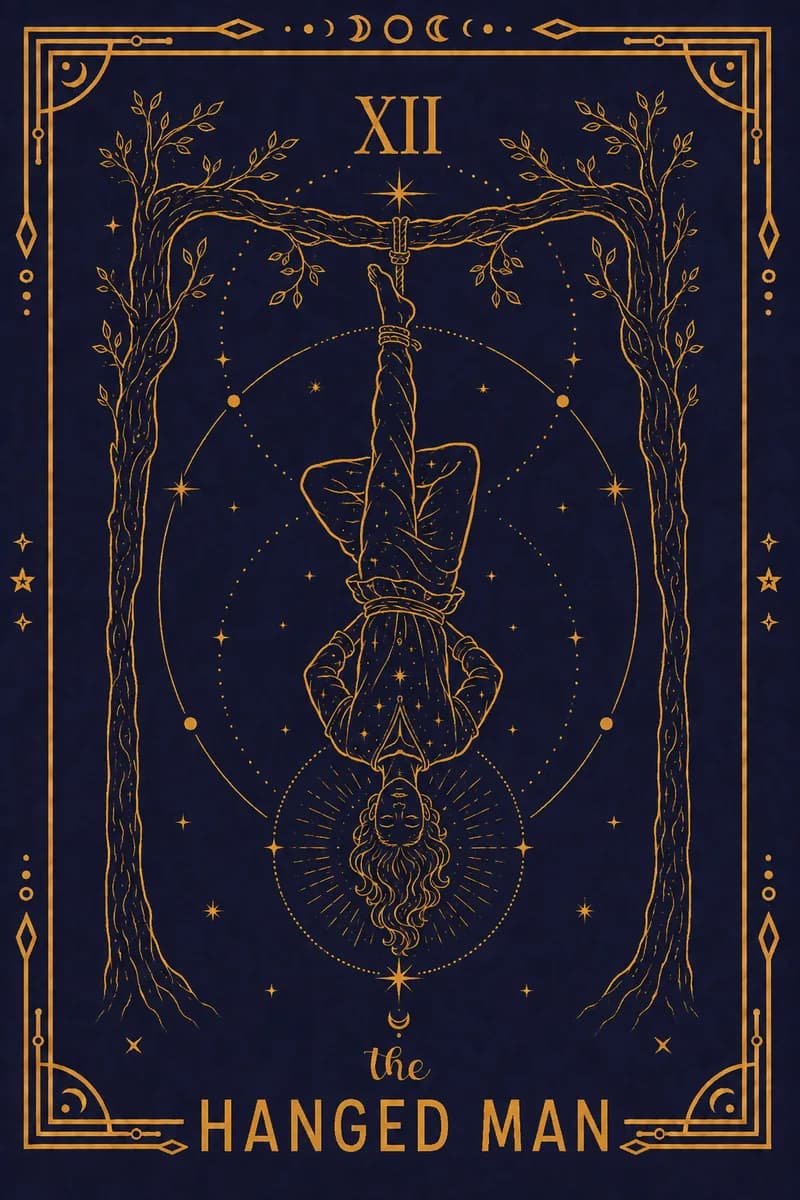
The Hanged Man is suspension entered willingly. He is not being punished. The rope is loose, his hands are behind his back by choice, and he could climb down. He stays because the inverted view shows him something the upright one never would. The halo appears only in this position, which is the tradition making its argument in a single detail: **the thing he can see is unavailable from any other angle.** Waite was explicit that the card means life in suspension and specifically warned against reading it as martyrdom or as death. Its one real difficulty is that a chosen pause and an enforced one look identical from outside, and often from inside too.
Affirmation
“I stop pushing and let the view change.”
The Hanged Man is suspension entered willingly. He is not being punished. The rope is loose, his hands are behind his back by choice, and he could climb down. He stays because the inverted view shows him something the upright one never would.
The halo appears only in this position, which is the tradition making its argument in a single detail: the thing he can see is unavailable from any other angle. Waite was explicit that the card means life in suspension and specifically warned against reading it as martyrdom or as death.
Its one real difficulty is that a chosen pause and an enforced one look identical from outside, and often from inside too.
Pause. Surrender the need to act. A different perspective is the whole point, and it will not arrive while you are still pushing. Sacrifice something now for a view you cannot otherwise get.
The card is precise about what is being given up: not the goal, but the timetable, and the sense of being the one moving things along. That is usually the harder loss.
In an advice position it is one of the few cards that will tell you to do nothing, on purpose, for longer than is comfortable. It is a poor card for a deadline and a good one for a decision that keeps producing the same unsatisfying answer.
Stalling disguised as reflection. Martyrdom, sacrifice performed for an audience. Or a needed pause resisted so hard that the situation forces it on you anyway.
The test the tradition offers for the first is simple and unkind: a genuine pause changes how you see the thing, and stalling leaves it exactly where it was. Six months of thinking about it that has produced no new view is the reversal.
The martyrdom reading deserves its own note, because it is common and it is rarely conscious. A sacrifice being kept account of is not the same as a sacrifice made, and the card reversed is often pointing at the ledger rather than at the giving.
A relationship in suspension, waiting on something unresolved: a decision somebody has not made, a situation elsewhere in a life, a question that keeps being deferred because asking it would settle things.
It is also the card of seeing a partner differently after a period of stillness, which is one of the genuinely good things it offers. Long relationships accumulate a fixed picture of the other person, and the card describes that picture coming loose.
Reversed, one person sacrificing endlessly and keeping score of it. That is the pattern where the giving is real and the resentment is also real, and the two coexist for years. The card names it without prescribing anything.
As somebody's feelings, it reads as suspended: something is felt and is not being acted on, and the reason usually sits outside the relationship rather than inside it. That is a genuine answer and an unsatisfying one.
A project stalled, a decision deferred, a career on hold. Fighting it will not shorten it. Use the pause, because the reframe available here is worth more than the lost weeks.
It covers the whole family of waiting: notice periods, funding rounds, applications with somebody else, restructures announced and not executed. The tradition's consistent position is that the outcome is not currently in your hands and acting as though it is wastes the interval.
The practical reading is to use the pause for the thing that only a pause allows: the skill, the rest, the reconsideration of whether you wanted the outcome you have been waiting on. In a stuck career this is often the card that asks the useful question.
Finances frozen or in limbo: an application pending, a sale not completing, money that exists and is not available.
Not the moment to force a move. The card is associated with arrangements that resolve on somebody else's schedule, and with the cost of trying to accelerate them.
Reversed, a sacrifice made for money that is costing more than it returns. The job kept for the salary, the arrangement endured for the security, the years given to something on the understanding that it would be worth it. The card asks for the sum to be done rather than assumed.
Surrender proper: letting go of control as a practice rather than as a defeat. Neptune dissolves the outline you were defending.
The card sits at the centre of every tradition that treats the self as something to be loosened rather than strengthened, and it is honest that this is uncomfortable and looks from outside like giving up.
Associated with contemplative stillness, with fasting and with any practice whose method is subtraction. Its claim is narrow and old: some things are only visible from a position you would not choose.
Enforced rest, and recovery that will not be rushed. The card is associated with convalescence, with the period after something acute, and with conditions whose only real treatment is time.
Read as reflection rather than diagnosis, its counsel is the same in both orientations and unusually blunt: stop. Upright it is a pause taken; reversed it is exhaustion from self-sacrifice, where the stopping has been postponed until the body has arranged it for you.
Neptune's association also makes this a card the tradition links to things that are hard to pin down. That is precisely the situation where a deck is least useful and a doctor is most, and the card is a reason to make the appointment rather than to keep waiting.
For reflection and entertainment. Not medical, legal, or financial advice.
He hangs from a living T-cross by one ankle, the free leg crossed behind: the figure of a traitor's punishment, wearing an expression of complete calm. The halo around his head appears only in this inverted position. His hands are behind his back, deliberately not intervening.
The pose is pittura infamante, the Italian public shaming portrait in which debtors and traitors were painted hanging upside down. The occultists inverted the meaning as thoroughly as the figure. Waite insisted the card indicates "life in suspension" and specifically warned against reading it as martyrdom or death.
Written by Memento Arcana against the Rider-Waite-Smith deck and the Golden Dawn attributions it was built on. No part of it was generated by a language model. Last updated 17 August 2026.
Where traditions disagree about this card, the page says so rather than picking one quietly. How we write these, and our sources.
How The Hanged Man has actually shown up for other readers.
Nothing here yet. Be the first to say how this card has landed for you.
Guides to reading this card alongside the other 77.
Seventy-eight cards is a lot to memorise and you do not have to. The structure that turns most of the deck into logic, and the habit that does the rest.
Two cards together mean more than two cards apart. A four-step method: dominant card, elements, the tension between them, then back to your question.
The 22 majors are the themes you do not choose. The 56 minors are daily life. What each half does, and what it means when one dominates a reading.