
How to Learn Tarot Card Meanings Without Memorising
Seventy-eight cards is a lot to memorise and you do not have to. The structure that turns most of the deck into logic, and the habit that does the rest.
 The Chariot
Major Arcana · VII
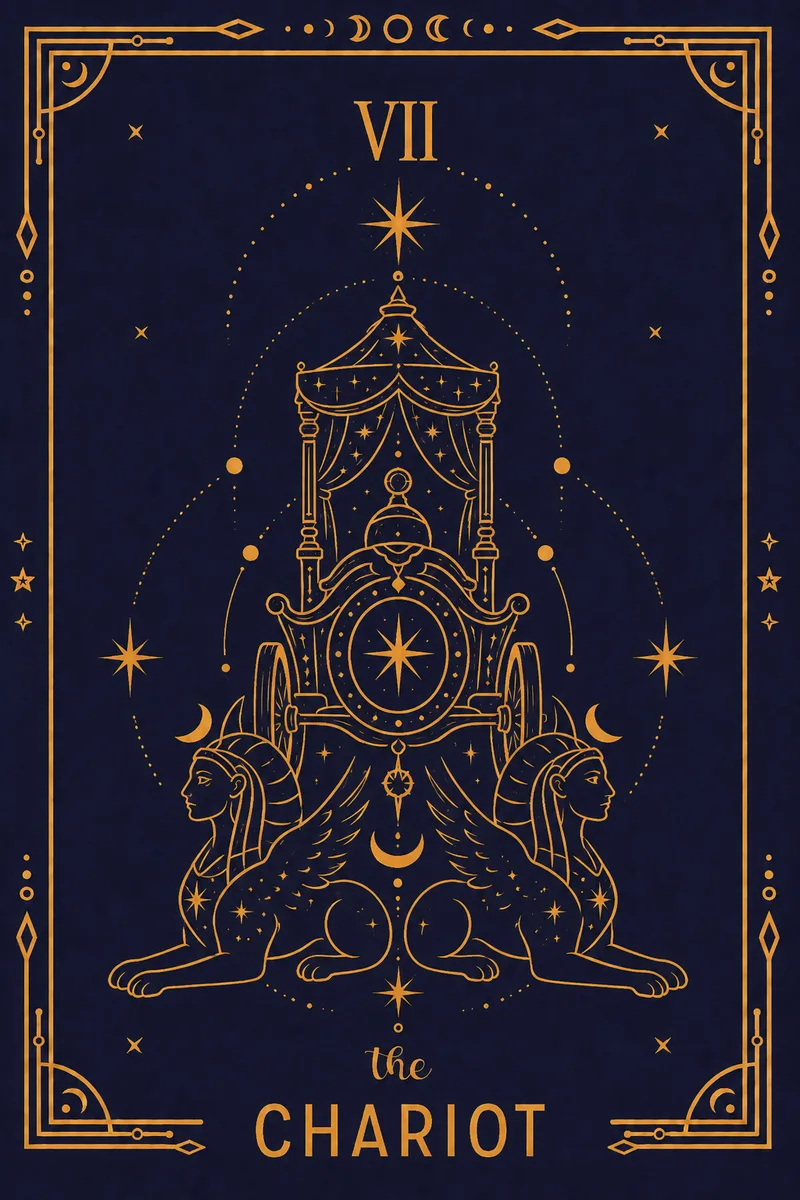
The Chariot is forward motion held together by will. Two opposing forces are yoked and driven in one direction, and nothing about that is effortless. The control is active, and it has to be maintained the whole way. The detail that carries the card is that **the charioteer holds no reins.** The sphinxes are moved by will alone, and they are pulling different ways. Nothing in the picture suggests this arrangement is stable; it suggests it is being held, continuously, by the person standing in it. The chariot is also not shown moving. The tradition reads the card as the tension itself rather than as the journey, which is why it fits situations that require sustained effort to stay on course far better than it fits arrivals.
Affirmation
“I hold my direction even when the parts of me disagree.”
The Chariot is forward motion held together by will. Two opposing forces are yoked and driven in one direction, and nothing about that is effortless. The control is active, and it has to be maintained the whole way.
The detail that carries the card is that the charioteer holds no reins. The sphinxes are moved by will alone, and they are pulling different ways. Nothing in the picture suggests this arrangement is stable; it suggests it is being held, continuously, by the person standing in it.
The chariot is also not shown moving. The tradition reads the card as the tension itself rather than as the journey, which is why it fits situations that require sustained effort to stay on course far better than it fits arrivals.
Determination, momentum, a hard-won victory. Focus everything on one direction and go. This is the card of travel, of campaigns, and of the discipline it takes to hold a course when the pieces pulling you would rather scatter.
Its particular strength is in situations with genuine internal opposition: part of you wants this and part of you does not, and the card says go anyway, without waiting for the disagreement to resolve. It never claims the sphinxes agree. It claims they can be driven.
In an advice position it favours one direction over several, a deadline over an open horizon, and finishing over reconsidering. It is a poor card for anything that would benefit from being reopened.
Loss of direction, or force without steering. Spinning the wheels. It can mean aggression standing in for competence, or a will so tight that everything around it has started to crack.
The most useful version of the reversal is the second: effort that has become a substitute for thinking. Somebody working extremely hard in a direction nobody has checked recently is the characteristic picture, and it is hard to spot from inside because the effort feels like evidence.
Also read for the sphinxes winning, where the opposing pulls have taken over and the vehicle is going somewhere nobody chose. That is the version where stopping, which the card upright refuses to consider, becomes the correct move.
Pursuing what you want directly, and overcoming an obstacle together. The card is associated with couples who are getting through something as a unit: a move, an illness, a hard year, a plan that requires both people pulling.
It is also, at the beginning of something, the card of unambiguous pursuit. Somebody has decided and is acting on it, and there is nothing coy about the picture. Where the Lovers weighs and the High Priestess waits, the Chariot arrives.
Reversed, it warns of a relationship driven by one person's will, or two people going hard in opposite directions and calling it independence. The second is the quieter failure: two busy lives, each defensible, gradually sharing nothing except an address.
As somebody's feelings, it reads as strong, active and directed towards you. It says little about tenderness and a lot about intent, which is worth knowing before reading it as more than it is.
Ambition rewarded. A promotion or contract won by sheer drive. Excellent for competitive fields, sales, litigation and anything with a deadline attached. Frequently indicates literal travel or relocation, and that reading is old enough to be worth taking seriously.
It favours the push: the quarter where everything goes into one target, the launch, the campaign, the application that gets made rather than perfected. Cancer's rulership gives it more emotional investment than its reputation suggests, so it often appears where the work matters personally.
The practical reading is that the situation will yield to sustained pressure and has not yet been given any. Where somebody is deciding between two directions, this is not the card for it; where they have decided and are hesitating, it is exactly the card.
Financial progress through effort and focus. Money moving, usually because somebody has gone and got it: the extra work taken on, the invoice chased, the negotiation entered rather than avoided.
The card is comfortable with aggressive short-term effort in a way the Empress and Emperor are not. It is a poor card for patience and a good one for a concentrated push at a specific number.
Reversed, expensive impulsiveness, and specifically momentum carrying a decision past the point anybody examined it. The vehicle is going somewhere nobody chose, which in money terms is usually a commitment that made sense three steps back.
Mastery of the self, and particularly of the emotional self. Cancer's water inside Cheth's enclosure: feeling contained and directed rather than suppressed or indulged.
The distinction matters, because the card is often misread as control in the sense of shutting down. The crescent moons sit on the charioteer's shoulders; the emotions are carried into the journey rather than left behind it. What is being disciplined is the direction, not the feeling.
Associated with practice that requires showing up regardless of state, and with the finding that will can carry a practice through periods when devotion cannot.
Strong recovery through disciplined effort, and a good card for anything that responds to consistency: rehabilitation, training, a protocol with a defined end point.
Cancer rules the stomach and chest, and read as reflection rather than diagnosis the card is traditionally associated with stress landing in the digestion. The characteristic pattern is somebody driving hard while their body registers the cost somewhere they are not looking.
Its consistent counsel is that the fix is pacing rather than more force, which is the one instruction the Chariot finds hardest to take. Anything persistent belongs with a doctor, and this card in particular describes the type of person who will put that off.
For reflection and entertainment. Not medical, legal, or financial advice.
The charioteer holds no reins. The black and white sphinxes are moved by will alone. The starry canopy places the journey under cosmic order; the crescent moons on his shoulders are the emotions he carries into it. Notably, the chariot is not shown moving: the tension is what the picture is about.
A Roman triumph in origin: the victorious general's procession, which is why victory is the card's oldest reading. Marseille decks used horses; Waite's sphinxes come from Éliphas Lévi, who explicitly linked them to Oedipus and the riddle, making the drivers of the chariot a question to be answered rather than animals to be whipped.
Written by Memento Arcana against the Rider-Waite-Smith deck and the Golden Dawn attributions it was built on. No part of it was generated by a language model. Last updated 17 August 2026.
Where traditions disagree about this card, the page says so rather than picking one quietly. How we write these, and our sources.
How The Chariot has actually shown up for other readers.
Nothing here yet. Be the first to say how this card has landed for you.
Guides to reading this card alongside the other 77.
Seventy-eight cards is a lot to memorise and you do not have to. The structure that turns most of the deck into logic, and the habit that does the rest.
Two cards together mean more than two cards apart. A four-step method: dominant card, elements, the tension between them, then back to your question.
The 22 majors are the themes you do not choose. The 56 minors are daily life. What each half does, and what it means when one dominates a reading.