
How to Learn Tarot Card Meanings Without Memorising
Seventy-eight cards is a lot to memorise and you do not have to. The structure that turns most of the deck into logic, and the habit that does the rest.
 Strength
Major Arcana · VIII
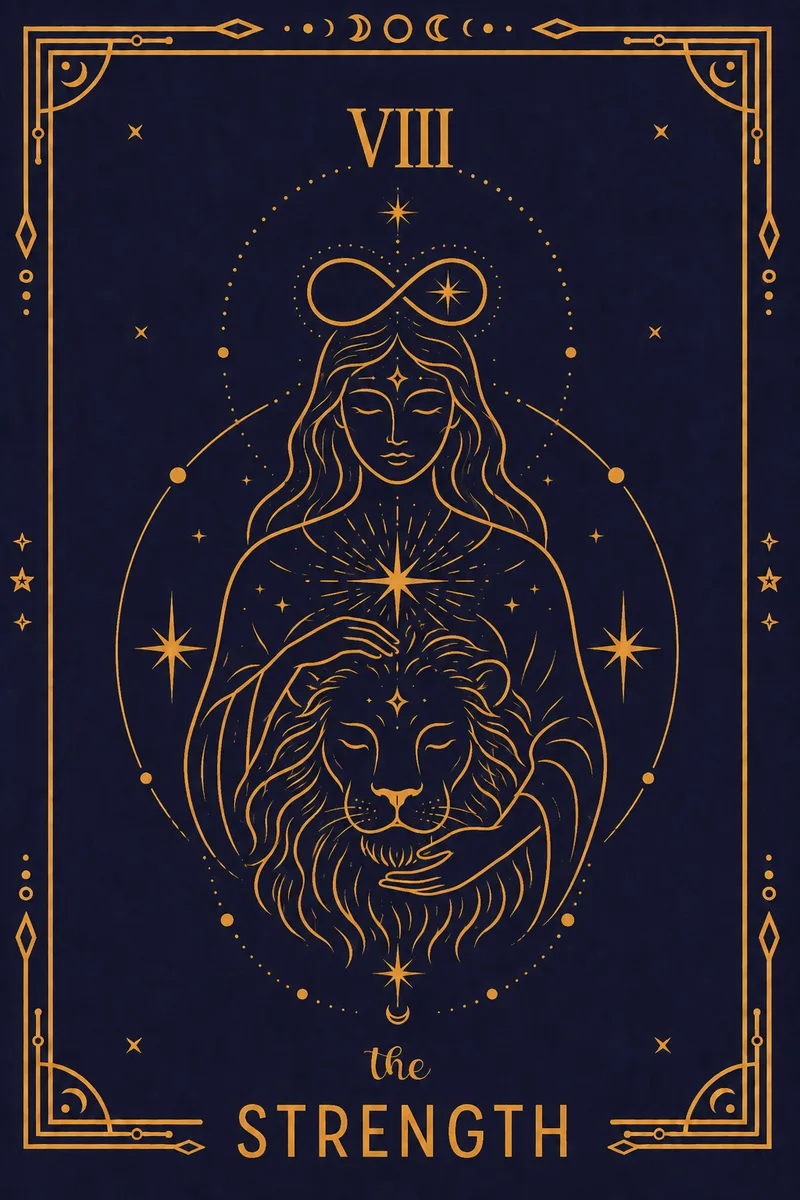
Strength is power that does not need to dominate. The lion is not defeated, it is calmed, and the card insists that this is the harder and more durable form of control. Patience where force would be quicker and worse. The woman wears white and a chain of flowers rather than armour, and closes the jaws with no visible effort. **Every element of the picture is arranged to show that nothing is being overpowered.** The lemniscate above her head is The Magician's, which is the tradition saying plainly that this is the same infinite power turned inward instead of outward. It is also the card of being more equal to something than you believe. That reading is old, consistent, and one of the few genuinely encouraging things the deck says without qualification.
Affirmation
“I meet what frightens me without hardening against it.”
Strength is power that does not need to dominate. The lion is not defeated, it is calmed, and the card insists that this is the harder and more durable form of control. Patience where force would be quicker and worse.
The woman wears white and a chain of flowers rather than armour, and closes the jaws with no visible effort. Every element of the picture is arranged to show that nothing is being overpowered. The lemniscate above her head is The Magician's, which is the tradition saying plainly that this is the same infinite power turned inward instead of outward.
It is also the card of being more equal to something than you believe. That reading is old, consistent, and one of the few genuinely encouraging things the deck says without qualification.
Courage, composure, influence through steadiness. You are more capable of handling this than you think. The card favours anyone managing their own temper, appetite or fear, and it rewards gentleness applied consistently.
The emphasis on consistency is the whole technique. Strength is not a heroic act; it is the same calm response repeated until the thing being calmed learns the pattern. It works on animals, on children, on colleagues and on your own reactions, by the same mechanism and at the same speed.
In an advice position it is unusually specific: do the gentle thing again, and do not escalate. The card is aware that escalation would be faster, and its position is that faster is not the same as finished.
Self-doubt, or raw force where restraint was needed. It can show the lion running the house: an impulse, addiction or anger that has stopped being managed. Sometimes it is simply exhaustion, compassion spent down to nothing.
That last reading deserves more room than it usually gets. Strength reversed frequently describes somebody who has been gentle and patient for a very long time and has nothing left, which is not a character failure and does not respond to being told to try harder. The card reversed is often a request for relief rather than for resolve.
Where the surrounding cards are harsher, the reading is an appetite that has stopped being negotiated with. The tradition treats that seriously and without contempt, which is the correct register for it.
Patience with a partner's difficulty. Love that holds without gripping, and that stays steady while somebody else is not.
It is the card of the relationship that survives a bad period because one or both people declined to meet difficulty with difficulty. The tradition is warm about this and also honest that it is expensive: holding steadily costs something, and the cost is invisible from outside.
Reversed, a relationship where one person's unmanaged reactivity is setting the terms for everyone. That reading is worth stating plainly rather than softening: a household organised around not provoking somebody is a real pattern, the card names it, and naming it is not the same as advising anything. What to do about it is outside what a deck can say.
As somebody's feelings, it reads as warm, durable and not in a hurry. It is one of the few cards in this position that suggests somebody would still be there after a hard year.
Quiet influence beats loud authority. Leading through steadiness. Good for difficult colleagues, negotiation, and any role requiring you to stay calm while somebody else does not.
It favours the long game inside an organisation: reputation built by being the person who does not lose their temper, influence that accrues without a title, the meeting won by being the last one still being reasonable. Also strong for caring and teaching work, and for anything with animals.
The practical reading is that the situation is being handled correctly and slowly, and the temptation is to abandon that for something decisive. Strength usually advises against the decisive version, and it is usually right.
Financial self-control. Resisting the impulse purchase, holding a position through a dip, keeping to a plan that is working and is boring.
The card is unglamorous here and its advantage is temperament rather than technique. Most financial damage is done by acting on a feeling at speed, and Strength describes the capacity not to, which is worth more over years than any particular decision.
Reversed, the appetite is in charge: spending as regulation rather than as choice. The tradition treats that as a pattern to notice rather than a failing to punish, which is also the only way anybody has ever changed it.
Integration rather than suppression. The lion is not evil and is not to be killed. The appetites are to be befriended and directed, and this is the card's central spiritual claim.
It sits directly against every ascetic reading that treats the body and its wants as an enemy. Strength's position is that what is fought grows stronger, what is starved gets louder, and what is met calmly and repeatedly becomes governable.
Associated with practice around anger, craving and fear specifically, and with the finding that these respond to attention rather than to force.
Recovery through patience, and strong for anything requiring long-term behaviour change: the habit built over months, the rehabilitation that only works if it is done daily and unremarkably.
Leo rules the heart and spine, and read as reflection rather than diagnosis the card is associated with both the physical heart and with what people carry on their backs. Its characteristic advice is smaller and more often rather than harder.
Reversed, burnout from carrying too much for too long, which is the single commonest thing this card describes and the one most likely to have been going on for years. Nothing here is diagnostic. Exhaustion that does not lift with rest is a reason to see a doctor rather than to draw again.
For reflection and entertainment. Not medical, legal, or financial advice.
A woman closes a lion's jaws with her bare hands and no visible effort, wearing white and a chain of flowers rather than armour. The lemniscate over her head is The Magician's. The same infinite power, applied inwardly instead of outwardly.
The great renumbering: in the Marseille tradition Strength is XI and Justice is VIII. The Golden Dawn swapped them so the trumps would align with the zodiac in order, and Waite followed, which is why almost every modern deck has Strength at VIII and Justice at XI, and why some traditional decks still do not.
Written by Memento Arcana against the Rider-Waite-Smith deck and the Golden Dawn attributions it was built on. No part of it was generated by a language model. Last updated 17 August 2026.
Where traditions disagree about this card, the page says so rather than picking one quietly. How we write these, and our sources.
How Strength has actually shown up for other readers.
Nothing here yet. Be the first to say how this card has landed for you.
Guides to reading this card alongside the other 77.
Seventy-eight cards is a lot to memorise and you do not have to. The structure that turns most of the deck into logic, and the habit that does the rest.
Two cards together mean more than two cards apart. A four-step method: dominant card, elements, the tension between them, then back to your question.
The 22 majors are the themes you do not choose. The 56 minors are daily life. What each half does, and what it means when one dominates a reading.