How to Learn Tarot Card Meanings Without Memorising
Seventy-eight cards is a lot to memorise and you do not have to. The structure that turns most of the deck into logic, and the habit that does the rest.
 The Tower
Major Arcana · XVI
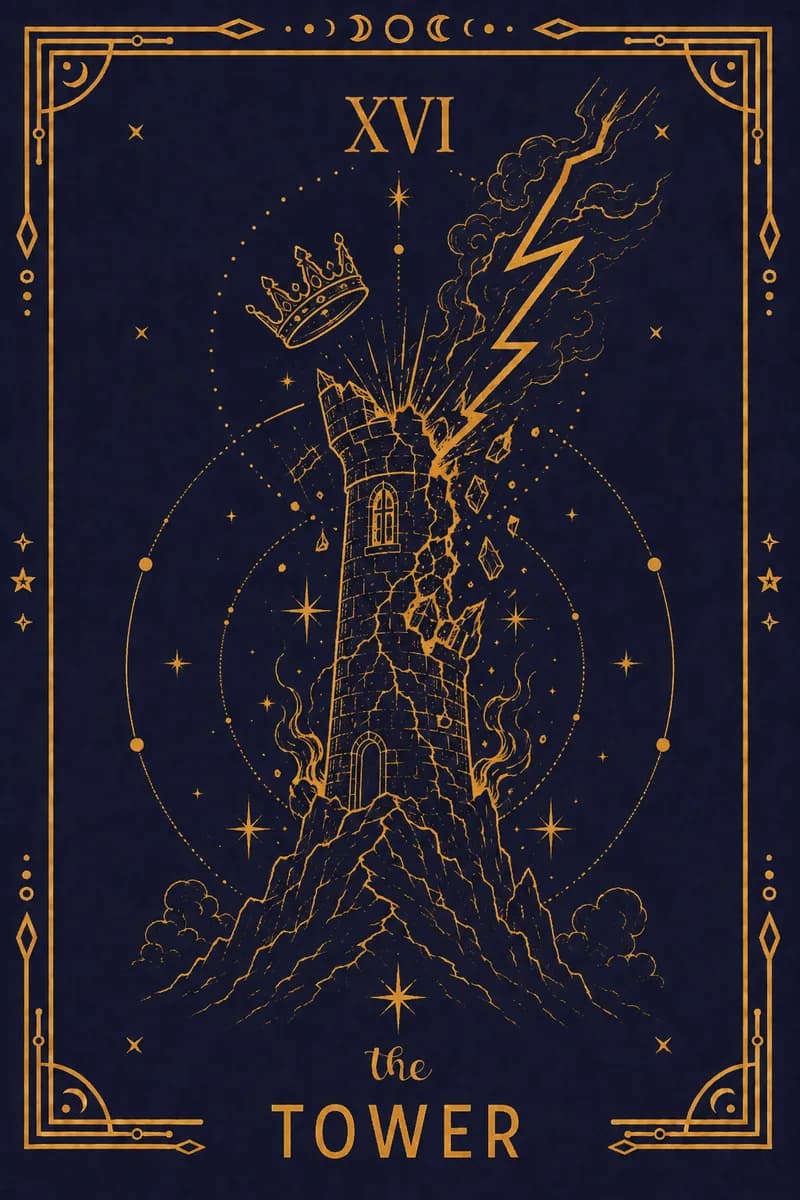
The Tower is sudden, unasked-for collapse. Something built on a false foundation comes down in one movement. It is the deck's most violent card and its most honest: what falls here could not have kept standing. The detail that carries the argument is the crown. Lightning knocks it off the top, and **the crown was never part of the structure to begin with.** What comes down is what was placed on the building rather than what was built. Twenty-two yods fall alongside the two figures, which the tradition reads as divine sparks: the destruction is not merely punitive. There is also no ground visible beneath them, only cloud, and the card declines to say how far the fall is.
Affirmation
“What falls was not able to hold me.”
The Tower is sudden, unasked-for collapse. Something built on a false foundation comes down in one movement. It is the deck's most violent card and its most honest: what falls here could not have kept standing.
The detail that carries the argument is the crown. Lightning knocks it off the top, and the crown was never part of the structure to begin with. What comes down is what was placed on the building rather than what was built.
Twenty-two yods fall alongside the two figures, which the tradition reads as divine sparks: the destruction is not merely punitive. There is also no ground visible beneath them, only cloud, and the card declines to say how far the fall is.
Upheaval, revelation, a structure destroyed. Job loss, a relationship ending overnight, a belief that cannot survive new information.
The speed is the point. There is no managed version of this card, and attempts to produce one are what the reversal describes. Whatever is happening is happening at its own pace and the available choice is about response rather than timing.
It is worth saying plainly, because people draw this card frightened: the Tower describes a structure failing, not a person. It is the most consistently misread trump after Death, and its actual claim is that the thing coming down was already unsound.
Disaster narrowly avoided, or a collapse delayed and prolonged. It can indicate resisting a necessary demolition: propping something up at increasing cost.
The delayed version is the crueller of the two. A collapse that happens quickly is over; one that is being resisted takes years, absorbs everything, and arrives anyway. The card reversed frequently describes somebody heroically maintaining a situation that would be better ended.
The kinder reading is real too. Some crises genuinely are averted, usually by somebody who saw it coming and acted, and the card reversed gives them credit for it.
A sudden rupture, or a truth that reorganises everything. The second is at least as common: nothing ends, and everything is now understood differently.
What the card describes is a structure failing rather than a feeling changing, which is why it can appear around revelations that ultimately strengthen a relationship. The version of the two of you that existed before the information is gone either way.
Reversed, a relationship in slow-motion collapse that neither person will name. Everybody involved usually knows. The card is describing the naming rather than causing anything, and the tradition holds that the slow version costs both people more than the fast one.
As somebody's feelings, it reads as upheaval rather than as a settled state: something has changed suddenly and is not yet resolved into anything. It is a poor position for this card, and the honest answer is that whatever is being felt now may not be what is felt next week.
Redundancy, a company failing, a public reversal. Genuinely destabilising, and the card offers no comfort in the moment.
What it does offer is retrospective, and the tradition is consistent about it: this is usually recognised as necessary within the year. That is worth very little to somebody in the week it happens, and pretending otherwise is the sort of forced positivity the card has no patience with.
The practical reading is narrow and useful. What is left standing afterwards is the part that was real, which includes skills, relationships and reputation that were never dependent on the structure that failed.
Sudden financial loss or shock. An arrangement exposed. Mars is fast and unsubtle, and the card describes events rather than trends.
Associated with the thing that was not in the plan: the bill, the failure, the discovery that a position was more exposed than it looked. Its counsel afterwards is triage rather than strategy.
Reversed, a crisis you saw coming and mitigated, which is one of the few unambiguously good reversals in the deck and is worth reading generously when it appears.
The destruction of false belief. What you were certain of turns out to have been scaffolding.
The card sits in every tradition that distinguishes between a framework and the thing it was built to reach, and it describes the moment the framework fails. Painful, clarifying, and by most accounts not optional for anybody who goes far enough.
Associated with the loss of a religious certainty as much as with its arrival, and the tradition treats the collapse of a belief that was doing real work as a serious event rather than an enlightenment.
Acute events rather than chronic conditions: a sudden diagnosis, an injury, something that arrives without warning. Mars rules inflammation and accidents in the traditional correspondence.
Read as reflection rather than diagnosis, and with the same caution as Death. A card cannot know anything about your health, and this one in particular should not be read as a warning of anything specific. Its association with acute events is a description of the card's character, not a forecast.
Where it is legitimately useful is as a prompt towards literal caution: the ladder, the tired drive, the thing you have been meaning to get looked at. If something has already happened, the card has nothing to add that a doctor does not have more of.
For reflection and entertainment. Not medical, legal, or financial advice.
Lightning strikes a tower and knocks off its crown; two figures fall headfirst, and the crown was never part of the structure to begin with. Twenty-two yods fall alongside them. Divine sparks, meaning the destruction is not merely punitive. There is no ground visible beneath them, only cloud.
Known variously as La Maison Dieu (the House of God), the House of the Devil, and Fire from Heaven. The naming was never settled. The imagery draws on the Tower of Babel and on medieval depictions of hellmouth. It is one of the very few tarot cards whose meaning has stayed essentially constant across five centuries.
Written by Memento Arcana against the Rider-Waite-Smith deck and the Golden Dawn attributions it was built on. No part of it was generated by a language model. Last updated 17 August 2026.
Where traditions disagree about this card, the page says so rather than picking one quietly. How we write these, and our sources.
How The Tower has actually shown up for other readers.
Nothing here yet. Be the first to say how this card has landed for you.
Guides to reading this card alongside the other 77.
Seventy-eight cards is a lot to memorise and you do not have to. The structure that turns most of the deck into logic, and the habit that does the rest.
Two cards together mean more than two cards apart. A four-step method: dominant card, elements, the tension between them, then back to your question.
The 22 majors are the themes you do not choose. The 56 minors are daily life. What each half does, and what it means when one dominates a reading.