How to Learn Tarot Card Meanings Without Memorising
Seventy-eight cards is a lot to memorise and you do not have to. The structure that turns most of the deck into logic, and the habit that does the rest.
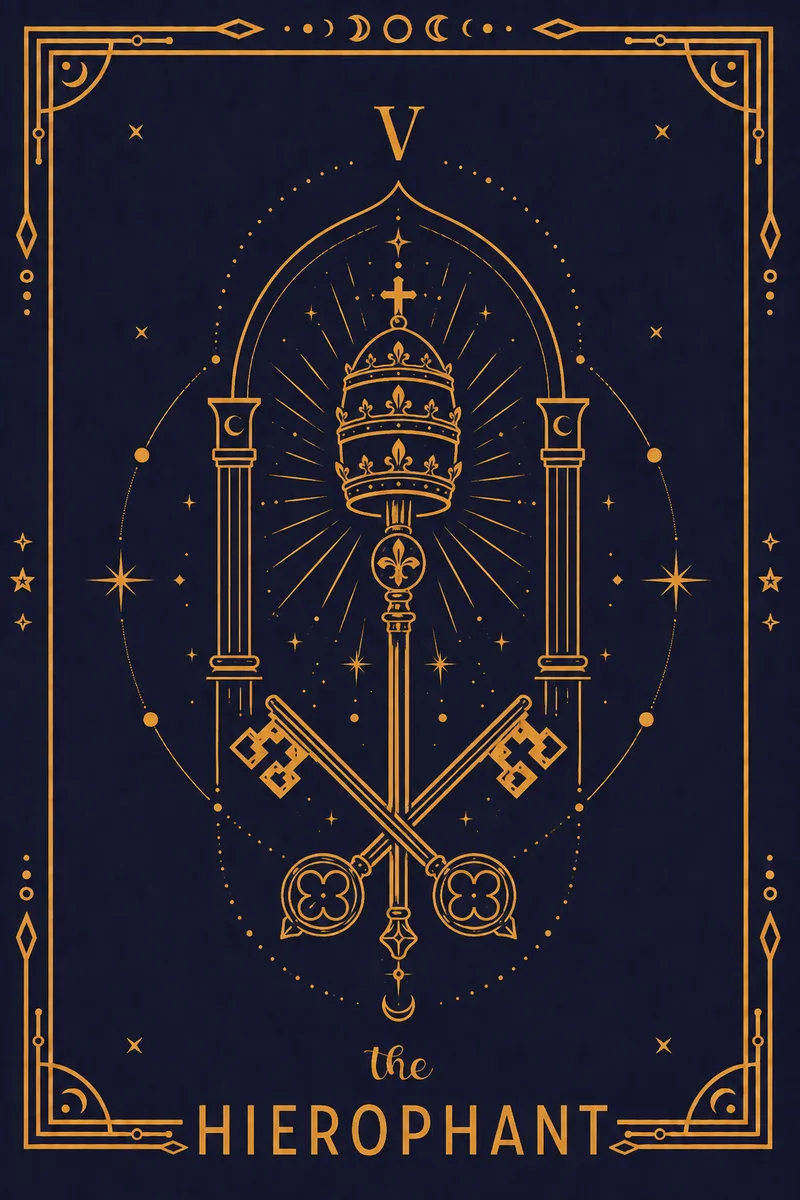 The Hierophant
Major Arcana · V
The Hierophant is inherited knowledge: tradition, institution, the teacher who stands between you and the thing being taught. He is the established route, with everything that offers and everything it costs. The crossed keys at his feet are the whole card. He controls access, and access is a real service and a real toll at the same time. **A tradition saves you the years it took to work something out, and charges you the requirement to accept how it was worked out.** He is the deck's most divisive trump, and the division tends to say more about the reader than the card. People who have been failed by institutions read him as a warning; people who have been saved by one read him as relief. Both are in the card.
Affirmation
“I learn what has already been learned before I try to improve on it.”
The Hierophant is inherited knowledge: tradition, institution, the teacher who stands between you and the thing being taught. He is the established route, with everything that offers and everything it costs.
The crossed keys at his feet are the whole card. He controls access, and access is a real service and a real toll at the same time. A tradition saves you the years it took to work something out, and charges you the requirement to accept how it was worked out.
He is the deck's most divisive trump, and the division tends to say more about the reader than the card. People who have been failed by institutions read him as a warning; people who have been saved by one read him as relief. Both are in the card.
Learn from someone who came before. Formal study, mentorship, ritual, marriage, religion, qualification. This card says the conventional path is genuinely the right one here, which is not something tarot says often.
That is worth dwelling on, because most of the deck is biased towards individuation and this card is not. Its counsel is that the situation you are in has been in front of other people before, that they wrote down what they found, and that reading it will cost you an afternoon and save you a year.
In an advice position he is specific: find the person who already knows, and let them correct you. He also favours doing things in the recognised order, including the tedious parts, on the grounds that the order usually exists for a reason.
The tradition no longer fits. Dogma without meaning, a teacher who should not be followed, rules kept out of habit. It also marks the point where you become your own authority: necessary, and rarely comfortable.
The second reading is the important one and the tradition is not defensive about it. Every lineage produces people who outgrow it, and the card reversed describes that moment without treating it as betrayal. It is uncomfortable because it removes a structure that was genuinely holding something.
The darker reading, where the surrounding cards support it, is authority that should not be trusted with the position it holds. The card does not flinch from that either, and it is worth reading plainly rather than softening when it appears next to something difficult.
Commitment with a public shape: marriage, meeting family, shared belief, the relationship that other people now know about. He is the most traditional partnership card in the deck and the one most concerned with the form a relationship takes rather than its feeling.
That is his strength and his limit. The Hierophant describes the part of a couple that is an institution: the arrangement, the expectations, the two families, what would have to be undone if it ended. All of that is real, and it is not the same thing as whether two people are happy.
Reversed, a relationship straining against expectation, or two people with incompatible values pretending that is a small thing. The second is the one worth taking seriously. Values that differ quietly for years tend to surface around a decision, and the card is often the warning before the decision rather than after it.
As somebody's feelings, he reads as serious intent of a conventional kind: this person is thinking about it in terms of what it would become rather than how it feels this week.
Institutions, education, qualification, apprenticeship. Working inside a system rather than against it. Strong for teaching, academia, law, medicine, and religious or civil service.
He favours the credential: the exam passed, the accreditation gained, the years put in that let you be taken seriously by people who do not know you. Where the Fool says begin unqualified, the Hierophant says qualify, and the two cards are answering different situations rather than disagreeing.
The practical reading is that the conventional route is available and is being avoided for reasons worth examining. Where somebody is doing everything except the accredited thing, he is usually pointing at that. Reversed, he flags the opposite case: an institution being served long after it stopped serving back.
Conservative, orthodox handling. Take proper advice, from somebody who is qualified and paid to give it rather than from a forum.
He favours the boring instruments and the long horizon: pensions, index funds, the arrangement everybody has because it works. Also associated with money that is bound up with an institution, from a mortgage to an inheritance to a professional body.
Reversed, it flags a scheme that departs sharply from convention, sometimes visionary and more often not. The card's question is not whether the idea is exciting. It is whether the people recommending it are exposed to the same downside you are.
Organised religion and lineage practice. The value of a tradition you did not invent and a teacher who can correct you.
He is the card for practice with a structure and a history: an order, a rule, a liturgy, a lineage that can tell you when you are doing it wrong. The tradition's claim, which is a reasonable one, is that correction is unavailable to a practice you designed for yourself.
Reversed, spirituality that must now be built personally, which the card treats as a real loss as well as a real necessity. He is also the trump most often paired with The Devil in reading, since the Devil sits in the same posture and blesses in the same gesture, and the pairing asks what you have agreed to belong to.
Follow the established protocol; see an actual professional. Taurus rules the throat and neck, and the card is traditionally associated with those and with the voice.
Read as reflection rather than diagnosis, he is the card that points away from the deck and towards the surgery. Where somebody has been managing something themselves for a long time, researching it endlessly, or treating it with what they read somewhere, the Hierophant is a fairly direct instruction to go and be assessed by somebody qualified.
Reversed, the standard treatment may not be the right one for you, and the honest reading of that is narrow: get a second opinion rather than abandoning treatment. The card reversed is not permission to stop taking something, and a site like this one has no business implying otherwise.
For reflection and entertainment. Not medical, legal, or financial advice.
He raises a hand in blessing while two initiates kneel below. The knowledge is being transmitted downward, in order. The triple crown and triple cross mark the three worlds; the crossed keys at his feet are the passage he controls access to. The pillars are grey: neither the black nor white of the Priestess, but the institution between them.
Originally Il Papa, the Pope, and the Popess's counterpart. Waite renamed him Hierophant after the chief priest of the Eleusinian Mysteries: a deliberate move away from a specific church toward the general figure of the initiator. Some early decks censored the card exactly as they censored the Popess.
Written by Memento Arcana against the Rider-Waite-Smith deck and the Golden Dawn attributions it was built on. No part of it was generated by a language model. Last updated 17 August 2026.
Where traditions disagree about this card, the page says so rather than picking one quietly. How we write these, and our sources.
How The Hierophant has actually shown up for other readers.
Nothing here yet. Be the first to say how this card has landed for you.
Guides to reading this card alongside the other 77.
Seventy-eight cards is a lot to memorise and you do not have to. The structure that turns most of the deck into logic, and the habit that does the rest.
Two cards together mean more than two cards apart. A four-step method: dominant card, elements, the tension between them, then back to your question.
The 22 majors are the themes you do not choose. The 56 minors are daily life. What each half does, and what it means when one dominates a reading.