The Lovers - Unisex Tee
From £17.95
View item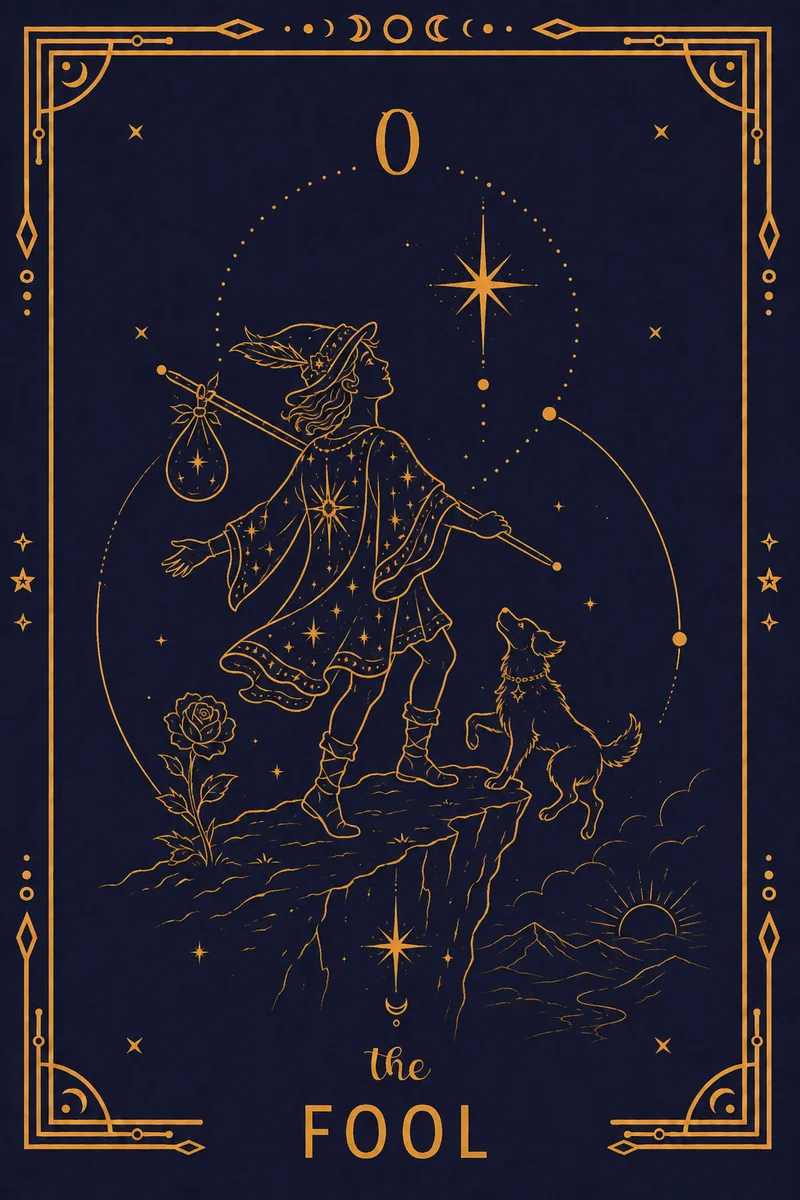 The Fool
Major Arcana · 0
The Fool is the beginning before the beginning: the moment you step out with no map, no track record and nothing to defend. It is numbered zero because it is not a stage of the journey so much as the willingness to start one, which is why it can be placed at either end of the sequence and still make sense. The card carries an ambiguity the tradition has never resolved and does not try to. The traveller is either about to step into open air or about to step onto a path the picture does not show, and the dog at his heel is either warning him or hurrying him along. Readers who insist on one answer are adding something. **What The Fool reliably describes is the state of not knowing yet, held without panic.** In most spreads it is read less as an event than as a posture: whatever else the reading contains, it is being met with fewer defences than usual.
Affirmation
“I begin before I feel ready, and I let the road teach me.”
The Fool is the beginning before the beginning: the moment you step out with no map, no track record and nothing to defend. It is numbered zero because it is not a stage of the journey so much as the willingness to start one, which is why it can be placed at either end of the sequence and still make sense.
The card carries an ambiguity the tradition has never resolved and does not try to. The traveller is either about to step into open air or about to step onto a path the picture does not show, and the dog at his heel is either warning him or hurrying him along. Readers who insist on one answer are adding something. What The Fool reliably describes is the state of not knowing yet, held without panic.
In most spreads it is read less as an event than as a posture: whatever else the reading contains, it is being met with fewer defences than usual.
A genuine new chapter, entered without a plan. Say yes before you feel ready. The card favours beginner energy: curiosity over expertise, movement over analysis, faith that the ground will meet your foot.
What it asks for specifically is the willingness to be visibly inexperienced. The Fool does not reward the person who waits until they can do the thing competently and then arrives looking as though they always could. It rewards starting in public, badly, and letting that be the situation.
It is also the card most associated with not needing the outcome to justify the decision. Where other cards ask what a step will produce, this one asks whether you would take it anyway.
Recklessness dressed up as spontaneity, or the opposite, standing at the edge and refusing to move. Ask which one it is. Reversed, The Fool also points to a leap taken to escape something rather than to reach something, which is the version that most often gets mistaken for courage.
The distinction the tradition draws is about what is behind you. A step taken towards something unknown is the card upright. A step taken away from something known is the same movement with a different engine, and it tends to arrive somewhere similar to where it left.
Also read as potential kept permanently in reserve: the plan described often and never begun, protected from failure by never being tested.
Early, unguarded attraction. A relationship with no defined shape yet, and that is the appeal rather than a problem to be solved. The card is associated with the period before the terms have been agreed, when neither person is managing an impression.
If partnered, it asks you to meet each other as strangers again rather than as a settled arrangement. That is not a criticism of the arrangement. It is a specific suggestion: the tradition reads The Fool in a long relationship as an invitation to be surprised by somebody you have already decided you know.
Where it is genuinely cautionary is about pace against information. The Fool describes moving before you have much to go on, which is a real and normal way to begin something, and is also how people end up a long way in before finding out anything important. The card does not say the feeling is wrong. It says you are early.
As somebody's feelings, it reads as interest that is present, unguarded and not yet committed to a shape, which is a different thing from either indifference or intent.
A career change with more instinct than evidence behind it. Freelancing, a first business, a role you are underqualified for on paper. Growth here comes from being visibly new, not from pretending competence.
The card sits well with situations where inexperience is an asset rather than a liability: work where an outsider's question is worth more than an insider's answer, early-stage projects with nothing established to defend, and any move sideways into a field where your existing expertise does not transfer and is not supposed to.
It is a poor card for anything that needs credentials, precedent or a track record, and the tradition is straightforward about that rather than encouraging. A Fool step into a role that requires demonstrated experience is not brave; it is the wrong card for the job.
An unproven venture or an unbudgeted risk. The card is not a warning against spending, but it is a warning against spending you have not actually looked at.
The association is with money committed on enthusiasm: the course bought in a burst of intent, the equipment for a hobby not yet started, the early investment in something whose numbers nobody has written down. None of that is condemned by the card, which is genuinely neutral about risk.
What the tradition draws attention to is the difference between a risk taken and a risk noticed. The Fool is happy to jump. It has nothing at all to say about whether you know how far the drop is, and that question is the reader's to add.
Beginner's mind. Practice unburdened by dogma or a sense of having arrived. The Fool is the soul before it has acquired a story about itself.
It is the card most often drawn for people starting a practice, and the one most often resented by people long inside one, because it describes returning to not knowing after years of accumulating a position. The tradition treats that return as the harder move of the two.
Associated with unstructured practice over formal instruction, with the question rather than the framework, and with the point at which a spiritual identity is put down rather than refined.
Energy returning after a flat period. A new regimen worth starting badly rather than not starting. Watch for carelessness. The cliff edge is literal in the imagery for a reason.
Read as reflection rather than diagnosis, the card describes appetite for change ahead of any plan for it: the run begun without stretching, the diet begun without shopping, the good intention that arrives before the arrangements do. Its usual counsel is to keep the enthusiasm and add one piece of preparation, not to wait for readiness that will not come.
Where it appears alongside difficulty, the tradition reads it as beginning again after something rather than avoiding it, which is a distinction worth being honest with yourself about. Nothing here replaces a doctor, and this card in particular is not a reason to postpone one.
For reflection and entertainment. Not medical, legal, or financial advice.
A young traveller steps toward a cliff with eyes raised, not down. The white rose is desire that has not yet become appetite; the small bundle is everything he owns, deliberately little. The white dog at his heel is instinct: either warning him or urging him on, and the picture refuses to say which.
In the earliest Italian tarocchi the Fool was Il Matto, an unnumbered wild card that belonged to no suit and could be played at any point, closer to a joker than a trump. The Golden Dawn placed it at the head of the sequence and gave it Aleph, the first Hebrew letter; earlier French decks often placed it at the end instead.
Written by Memento Arcana against the Rider-Waite-Smith deck and the Golden Dawn attributions it was built on. No part of it was generated by a language model. Last updated 17 August 2026.
Where traditions disagree about this card, the page says so rather than picking one quietly. How we write these, and our sources.
How The Fool has actually shown up for other readers.
Nothing here yet. Be the first to say how this card has landed for you.
Browse Our Store
Tarot decks, journals, prints and apparel, shipped worldwide.
Guides to reading this card alongside the other 77.
Seventy-eight cards is a lot to memorise and you do not have to. The structure that turns most of the deck into logic, and the habit that does the rest.
Two cards together mean more than two cards apart. A four-step method: dominant card, elements, the tension between them, then back to your question.
The 22 majors are the themes you do not choose. The 56 minors are daily life. What each half does, and what it means when one dominates a reading.