
How to Learn Tarot Card Meanings Without Memorising
Seventy-eight cards is a lot to memorise and you do not have to. The structure that turns most of the deck into logic, and the habit that does the rest.
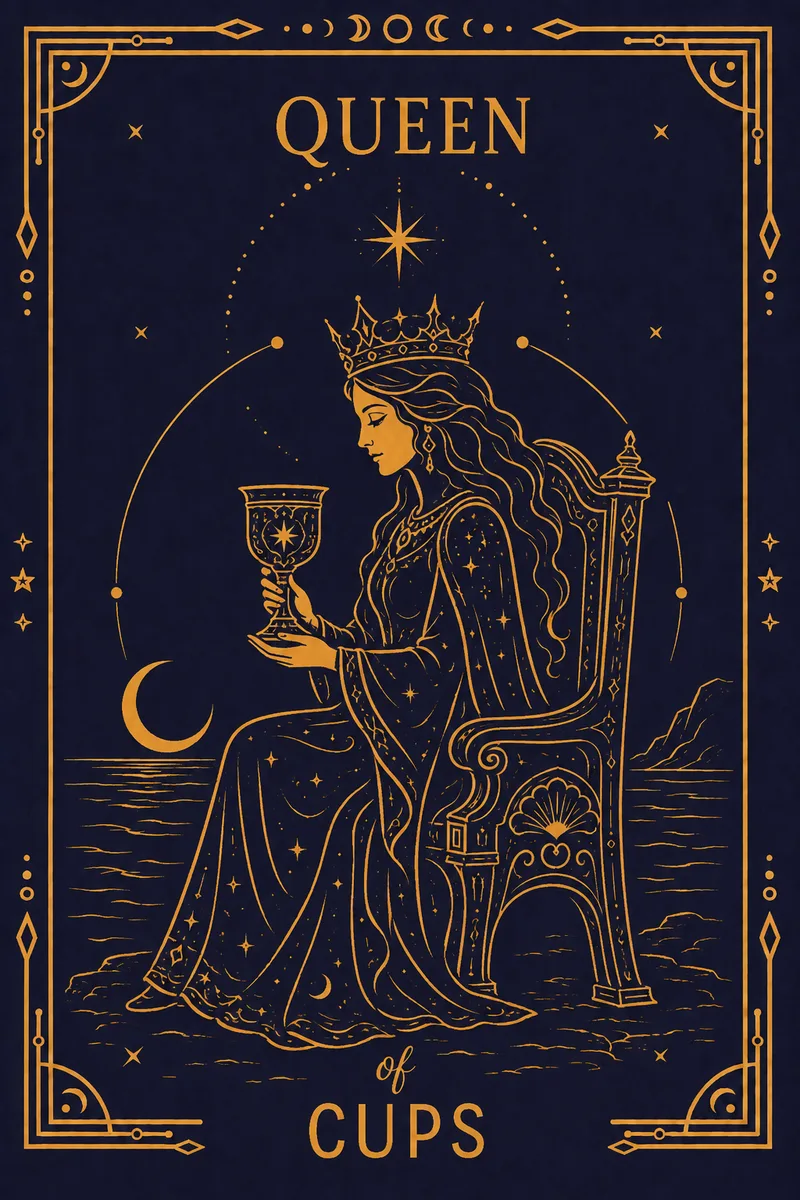 Queen of Cups
Cups · Court card
The Queen of Cups is emotional depth that has been mastered rather than merely felt. Intuitive, compassionate, and, unlike the rest of her suit, completely composed while being so. She holds the only closed cup in the suit, ornate and lidded with handles like angels, and she is the only court figure looking directly into what she holds. **She sees what is inside without needing to open it for anybody else**, which Waite noted specifically and which is the whole distinction between her and the rest of the suit. Everybody else in Cups is in the water. She is at its edge.
Affirmation
“I feel it fully and I do not drown in it.”
The Queen of Cups is emotional depth that has been mastered rather than merely felt. Intuitive, compassionate, and, unlike the rest of her suit, completely composed while being so.
She holds the only closed cup in the suit, ornate and lidded with handles like angels, and she is the only court figure looking directly into what she holds. She sees what is inside without needing to open it for anybody else, which Waite noted specifically and which is the whole distinction between her and the rest of the suit.
Everybody else in Cups is in the water. She is at its edge.
Deep empathy and intuition you can act on. Care given without losing yourself in it.
She describes somebody safe to bring difficult feeling to, which is a specific and uncommon capacity: not agreement, not advice, but the ability to hold something without being destabilised by it.
In an advice position she says trust your read of people, and she means the read you cannot evidence. Of all the cards that make that suggestion, she is the one with the best claim to it, because composure is what separates a read from a reaction.
Emotional overwhelm. Absorbing everybody else's feelings, care given until there is nothing left.
That is the common reading and it is a depletion rather than a fault. The capacity that makes her valuable is the same one that leaves her carrying things nobody asked her to carry, and she is characteristically the last to notice.
The harder reading, where the surrounding cards support it, is emotion used to control others: distress deployed, sensitivity that must be managed by everybody around it. The tradition names it without relish, and it is much rarer than the first.
A profoundly emotionally attuned partner. Love with real depth and real steadiness, which is a rarer combination than either alone.
What she offers specifically is accurate attention: being understood rather than being adored. People who have had one and not the other tend to describe the difference at length.
Reversed, codependency, where two people's emotional weather has merged and neither can locate their own, or emotional manipulation, which is the sharper end. The first is far more common and is usually built by both parties over years.
As somebody's feelings, she reads as deep, steady and quietly certain. This person has already understood more about you than they have said.
Counselling, care work, therapy, and anything requiring you to hold other people's difficulty without taking it home.
Also strong for management of the unglamorous kind: the person a team brings problems to, whose value is invisible until they leave. Cancer's rulership gives her the domestic and protective register.
Reversed, the emotional labour of a role that nobody counts as work. That is a real professional pattern, it is disproportionately carried by particular people in a team, and the card is direct about naming it.
Intuitive rather than analytical financial decisions, and the tradition is mildly cautious about that.
Her instinct about people is reliable and her instinct about numbers is not, and the two get conflated. A good judgement of who is trustworthy is not a judgement of whether the arrangement is sound.
Reversed, generosity that needs a boundary: money given to people whose situation does not change, repeatedly, at a cost she does not mention.
The deck's clearest psychic and intuitive figure, and inner work treated as a mastered discipline rather than a sensitivity.
The closed cup is the point. What she knows is not being displayed, and the tradition treats that discretion as part of the competence rather than as secrecy.
Associated with dreamwork, contemplative practice and the slow business of learning to tell your own feeling from somebody else's, which she is the deck's picture of having actually achieved.
Emotional health as the foundation of physical. Cancer rules the stomach and chest in the traditional correspondence.
Read as reflection rather than diagnosis, she is associated with a settled inner state showing up as a settled body, and with the observation that sleep, appetite and digestion move together with mood.
Reversed, empathy fatigue with a physical cost, which is well recognised in caring professions and among people looking after a relative. It is a genuine health matter rather than a failure of resilience, and it belongs in a conversation with a doctor rather than in a reading.
For reflection and entertainment. Not medical, legal, or financial advice.
She sits at the water's edge gazing into an ornate lidded cup with handles like angels. The only closed cup in the suit. She is the only court figure looking directly into what she holds.
Golden Dawn made her water-of-water alongside the Knight. Waite noted the closed cup specifically: she sees what is inside without needing to open it for anyone else.
Written by Memento Arcana against the Rider-Waite-Smith deck and the Golden Dawn attributions it was built on. No part of it was generated by a language model. Last updated 17 August 2026.
Where traditions disagree about this card, the page says so rather than picking one quietly. How we write these, and our sources.
How Queen of Cups has actually shown up for other readers.
Nothing here yet. Be the first to say how this card has landed for you.
Guides to reading this card alongside the other 77.
Seventy-eight cards is a lot to memorise and you do not have to. The structure that turns most of the deck into logic, and the habit that does the rest.
Two cards together mean more than two cards apart. A four-step method: dominant card, elements, the tension between them, then back to your question.
The 22 majors are the themes you do not choose. The 56 minors are daily life. What each half does, and what it means when one dominates a reading.